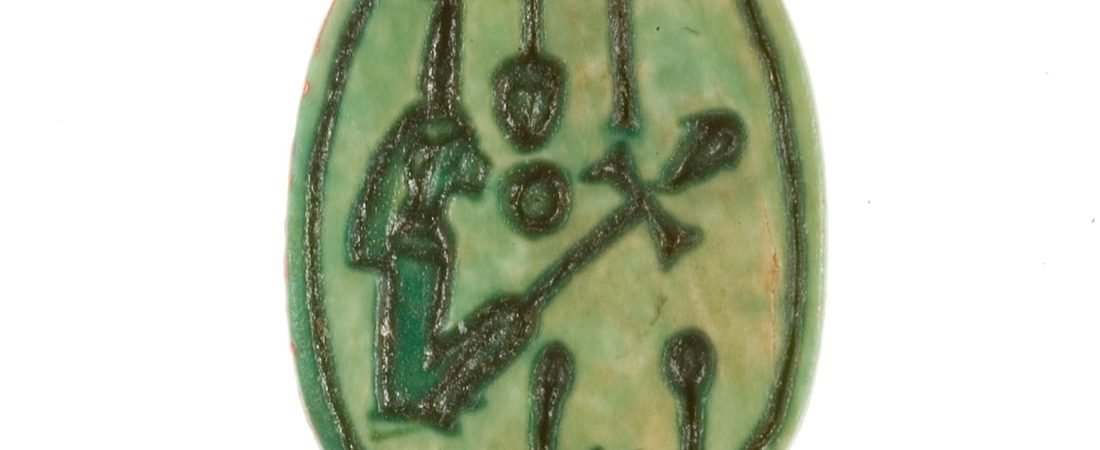
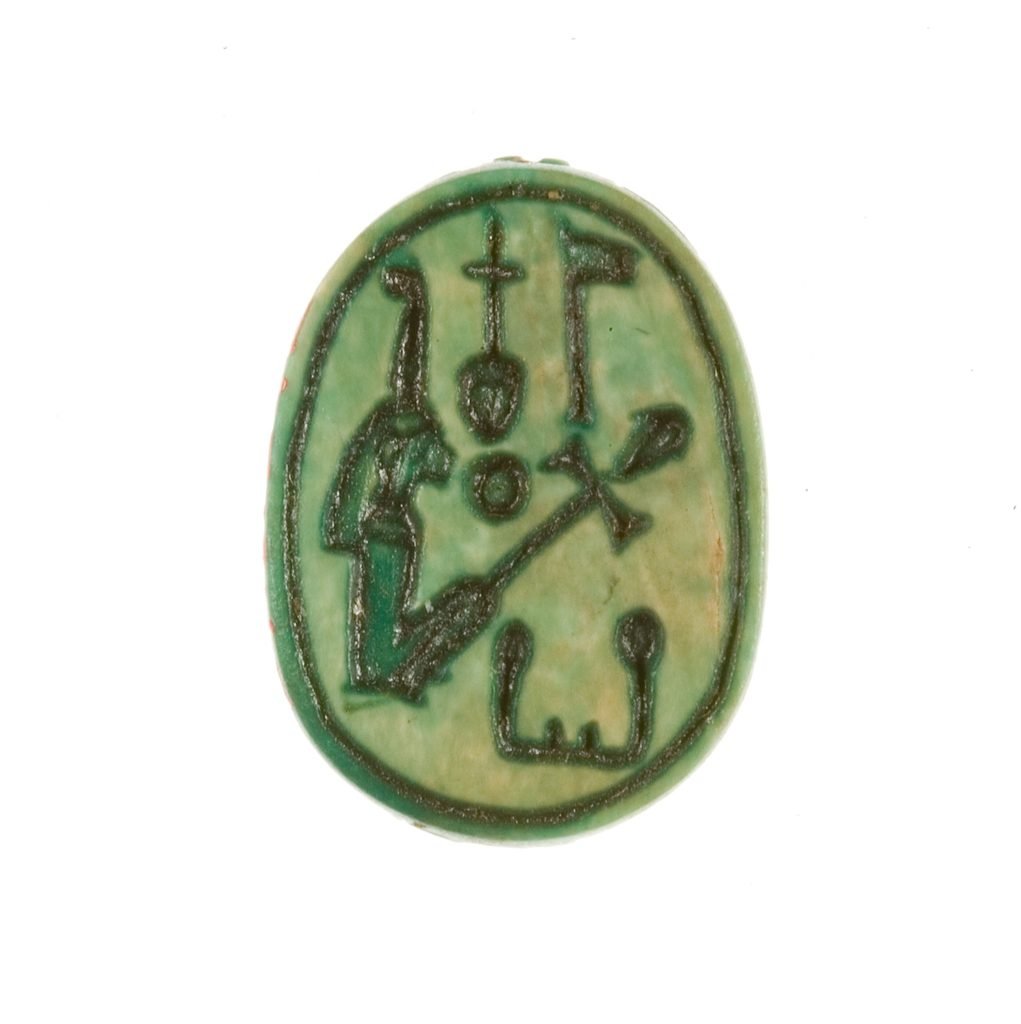
A green-glazed scarab from Hatshepsut’s temple at Deir el-Bahri measures just 1.6 centimeters long. Its underside carries her throne name, Maatkare. Archaeologists recovered it from a foundation deposit along the temple’s eastern enclosure wall. [7]
Ancient Egyptian foundation deposits were groups of objects deliberately buried in or near buildings during rites connected with construction. They were intended to help establish a building’s sacred character and secure its effectiveness and endurance. Their contents could include vessels, offerings, tools, and royal names. [2]
Those small objects now help answer larger questions about Egyptian monuments. What did their builders consider necessary before construction began? And how can a buried jar or miniature implement tell us who commissioned a building?
What Egyptian foundation deposits were
A foundation deposit is identified through its relationship to a building as well as its contents. UCL’s Digital Egypt resource describes offerings placed within foundations, beneath them, or close by. Corners were frequent locations, but deposits also occurred along walls, beneath courts, and on a temple’s central axis. [1]
That definition matters because an old object found underground is not automatically a foundation offering. Its position and association with other finds must support the interpretation. A pot buried as part of a building ceremony tells a different story from one discarded nearby during everyday use. [1]
Foundation deposits also occur around tombs. Their role concerns the establishment of the structure, which distinguishes them from equipment placed inside a burial chamber for its occupant. The same ruler might therefore be represented in deposits belonging to different projects, each requiring its own archaeological identification. [2]
Beginning construction with a ceremony
The Met’s account of foundation ceremonies describes the building’s outline being marked with cords stretched between wooden pegs. Pits were dug at selected points around its perimeter or along its axis, and offerings were placed inside. Practical preparation of the site formed part of a religious ceremony. [3]
Manchester Museum explains the deposits as a means of symbolically supporting the building’s lasting effectiveness. This helps make sense of the decision to bury carefully chosen things. Their placement had a purpose within the ceremony even though later visitors would usually encounter the finished building without seeing them. [2]
We should be cautious about turning this evidence into a single script performed identically everywhere. The surviving examples span different periods and building types. Their shared connection with construction does not mean that every pit contained the same objects or followed the same arrangement. [1] [2]
Why tools belonged beneath a building
Construction implements make the connection especially clear. Some deposits contained working tools; others included models. The Met records both possibilities, so it would be misleading to describe every buried implement as a miniature or assume that all were unsuitable for practical work. [3]
A wooden brick mold from the foundation deposit in front of Hatshepsut’s tomb, KV 20, is only 9.9 centimeters long. It represents equipment relevant to construction: the tomb entrance would have been closed with mud bricks. This ancient model belongs to the tomb deposit, rather than to her temple at Deir el-Bahri. [4]
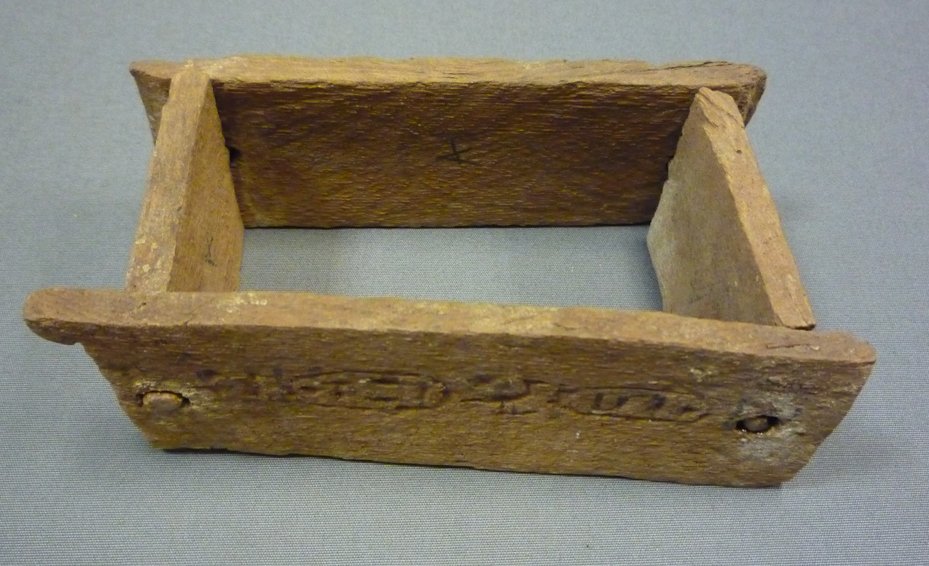
The model gives the reader a useful way to understand the larger practice. An implement could refer to an activity essential to making the structure. Its burial linked that activity to the building ceremony. Recognizing that relationship is more informative than treating the object simply as an unusual little tool. [3] [4]
Vessels and textiles widened the offering
The contents reached beyond construction equipment. Among the deposits associated with Hatshepsut’s temple, The Met records pottery with food, stone ointment jars, folded linen, and meat offerings. These selections brought provisions and materials into the ceremony alongside implements connected with building work. [8]
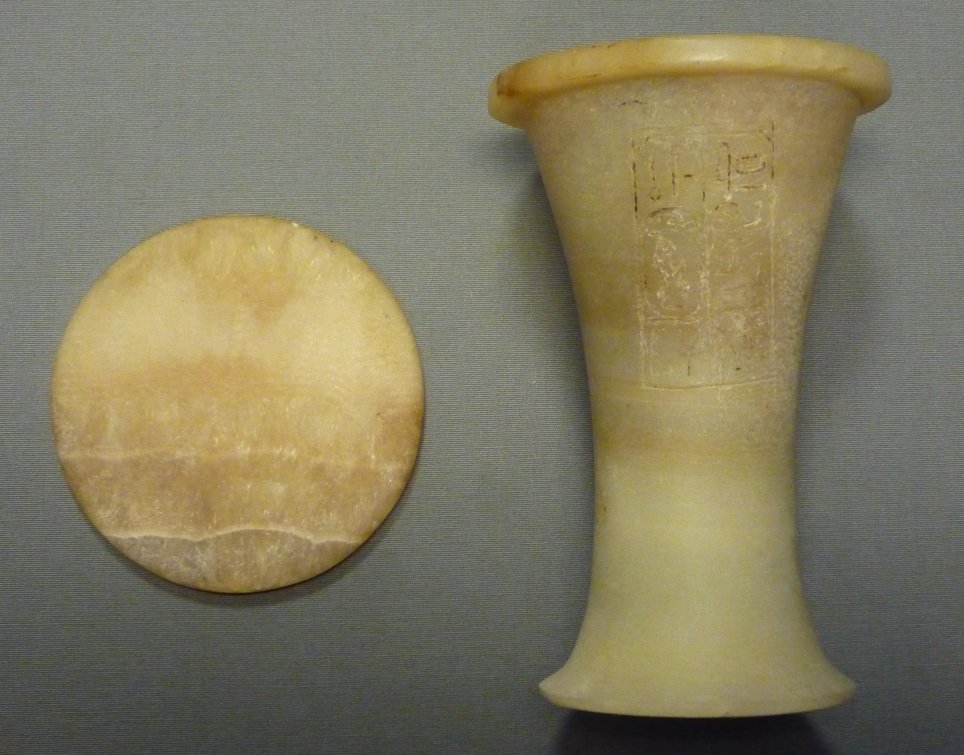
One surviving ointment jar, made of travertine, often called Egyptian alabaster, stands 12.5 centimeters high. It retains painted inscription traces and comes from Foundation Deposit 3 at the temple. Its documented findspot allows us to connect an individual vessel with a specific group of buried objects. [5]
A separate linen model sheet in the collection came from Foundation Deposit 2a at the same temple. Such records remind us that the surviving evidence includes more than durable stone and metal. A piece of cloth deserves attention because its material and archaeological association add to our understanding of what was selected. [6]
Royal names beneath Hatshepsut’s temple
The scarab at the beginning of this article belongs to a much larger assemblage. During the 1926–1927 season, The Met’s expedition recovered 299 scarabs and stamp-seals from three foundation deposits along the eastern enclosure wall. Their inscriptions included titles from different stages of Hatshepsut’s life and reign. [7]
A name therefore does more than decorate a small object. Read alongside its findspot, it can connect the deposit to royal patronage. The evidence combines writing with location: separating a scarab from its excavation record would remove part of what makes it historically useful. [7]
Museum presentation requires a similar distinction. The Met’s display called Reconstruction of a Foundation Deposit brings together a representative selection from several temple deposits. It helps visitors imagine the contents of a pit, but its arrangement should not be mistaken for an untouched excavation photographed in place. [8]
How buried objects help identify a builder
A foundation deposit helped resolve the identity of Hatshepsut’s tomb. According to The Met, Howard Carter was clearing the entrance of KV 20 in February 1903 when he found model tools and small jars bearing the name Maatkare. The find supported his identification of the tomb with Hatshepsut. [9]
This illustrates why inscriptions and archaeological context need to be considered together. A royal name on an object is useful evidence; a group of named objects connected with a structure’s foundation can address the more specific question of who commissioned it. The deposit records an association with the building’s beginning. [9]
A comparable use of the evidence appears in Egypt’s Ministry of Tourism and Antiquities report on Ramesses II’s temple at Abydos. The mission found foundation deposits containing plaques with his throne name, small copper tool models, and other offerings. The ministry interpreted the deposits as evidence that construction belonged to his reign, rather than to that of his father. [10]
That is a conclusion about this particular building and its excavated deposits. It should not become a rule that any object carrying a king’s name gives an exact construction date. The strength of the argument depends on how securely the objects are associated with the relevant building phase. [10]
A tradition that changed across time and setting
UCL’s survey shows changes in the practice. Old Kingdom deposits could contain provisions and vessels; Middle Kingdom examples include model tools. Later New Kingdom groups increasingly feature small faience objects and inscribed pieces. These patterns provide context for individual discoveries without making every deposit a standard kit. [1]
Royal monuments dominate many familiar examples, but the practice also raises questions about domestic buildings. In a 2018 study of Tell el-Dab’a, ancient Avaris, Miriam Müller examined evidence from a residential neighborhood. ASOR’s published abstract describes more modest household rituals and possible connections between Egyptian and Near Eastern traditions. [11]
This evidence broadens the discussion beyond pharaohs while keeping differences in scale visible. A royal temple deposit and a household example need to be understood within their own settings. Similar placement does not automatically establish identical participants, resources, or religious meanings. [11]
What the deposits preserve
Their value lies in this combination of modest objects and precise context. When looking at an Egyptian artifact, ask where it was found and what surrounded it. Those details may explain why something small was considered important enough to place beneath a monument.
Explore the museum records below to examine the objects, their inscriptions, and their documented findspots for yourself.
Sources and further reading
[1] University College London. Foundation deposits. 2002.
https://www.ucl.ac.uk/museums-static/digitalegypt/architecture/foundationdeposit.html
[2] Anna Garnett, Manchester Museum. Foundation Deposits in Ancient Egypt & Sudan. 2 September 2013.
https://egyptmanchester.wordpress.com/2013/09/02/foundation-deposits-in-ancient-egypt-sudan/
[3] The Metropolitan Museum of Art. Model Stone Rocker from a Foundation Deposit for Hatshepsut’s Temple. Object 96.4.9.
https://www.metmuseum.org/art/collection/search/547563
[4] The Metropolitan Museum of Art. Model Brick Mold from the Foundation Deposit for Hatshepsut’s Tomb. Object 30.8.7.
https://www.metmuseum.org/art/collection/search/573656
[5] The Metropolitan Museum of Art. Ointment Jar from a Foundation Deposit of Hatshepsut. Object 25.3.45a, b.
https://www.metmuseum.org/art/collection/search/544463
[6] The Metropolitan Museum of Art. Model Sheet from a Foundation Deposit for Hatshepsut’s Temple. Object 22.3.256.
https://www.metmuseum.org/art/collection/search/548758
[7] The Metropolitan Museum of Art. Scarab Inscribed for the Perfect God Maatkare (Hatshepsut). Object 27.3.242.
https://www.metmuseum.org/art/collection/search/559828
[8] The Metropolitan Museum of Art. Reconstruction of a Foundation Deposit. Object 25.3.39.
https://www.metmuseum.org/art/collection/search/544457
[9] The Metropolitan Museum of Art. Model Mason’s Float from the Foundation Deposit for Hatshepsut’s Tomb. Object 30.8.6.
https://www.metmuseum.org/art/collection/search/573655
[10] Egyptian Ministry of Tourism and Antiquities. New discovery of foundation deposits and the storerooms of Ramesses II’s temple in Abydos.
https://egymonuments.gov.eg/news/new-discovery-of-foundation-deposits-and-the-storerooms-of-ramesses-ii-s-temple-in-abydos/
[11] Miriam Müller; abstract published by ASOR. Foundation Deposits and Strategies of Place-Making at Tell el-Dab’a/Avaris. 2018. Near Eastern Archaeology 81(3), 182–190. The ASOR abstract was consulted; the full paper was not accessed.
https://www.asor.org/news/2018/09/nea81_3-toc/