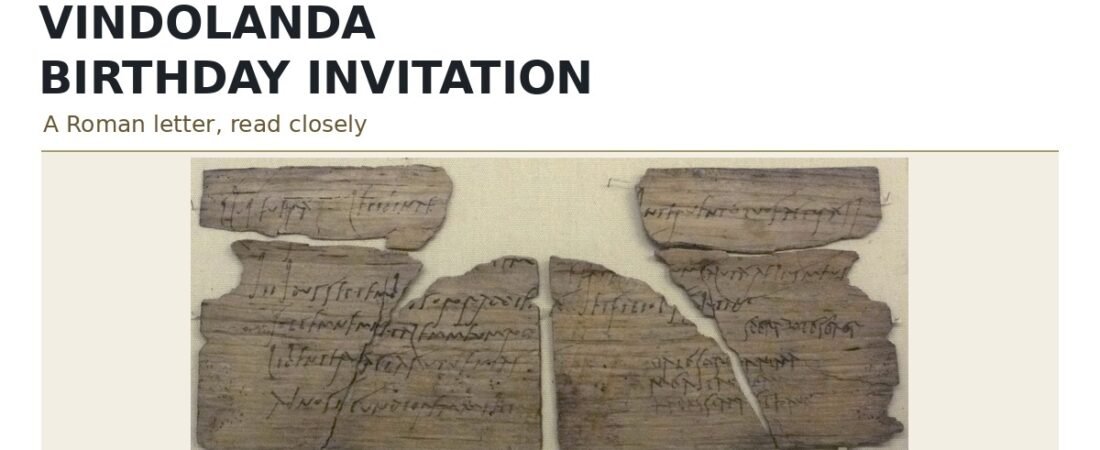
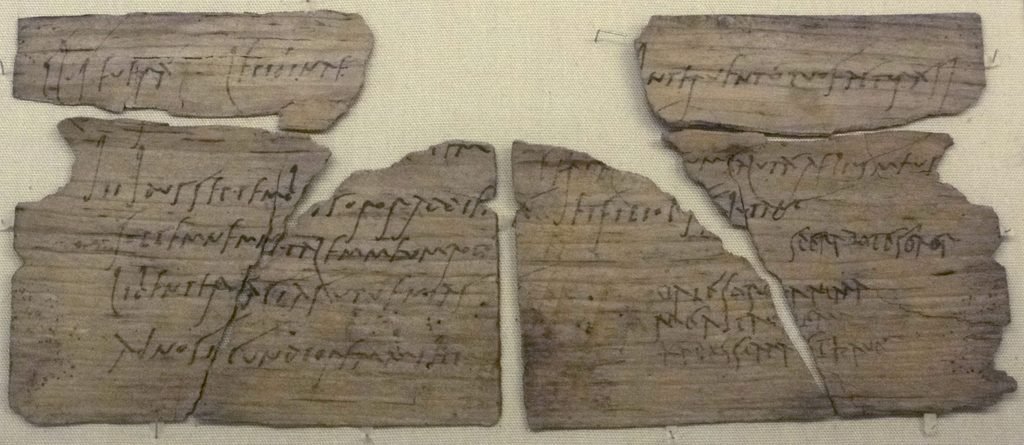

Near the end of a small wooden letter, the handwriting changes. A carefully written invitation gives way to a more personal closing: “I shall expect you, sister.” The Vindolanda birthday invitation, known as tablet 291, was sent by Claudia Severa to Sulpicia Lepidina. It invites her to celebrate Severa’s birthday on 11 September, sometime within the tablet’s archaeological date range of AD 97–105. [1]
The change of hand is central to its importance. Scholars identify the closing as Severa’s own writing. Here, a routine social arrangement becomes physical evidence of a woman taking up a pen in Roman Britain. Reading the letter closely also reveals how much a short message can leave unsaid. [2]
What does the Vindolanda birthday invitation say?
Severa asks Lepidina to come because her presence would make the birthday more enjoyable. She includes greetings involving their families, then adds the affectionate closing. The address on the back names Lepidina as the wife of Cerialis. The letter gives the day and month, but no securely identified year; AD 97–105 comes from its archaeological context. The surviving wood measures about 22.3 by 9.6 centimetres. [1]
That is enough to establish the purpose of the message. It cannot give us a guest list, a menu, Severa’s age, or confirmation that Lepidina attended. Imagining the occasion can make the letter feel familiar, but those imagined details should remain outside an account of what the evidence actually records.
Why are there two different hands?
Most of the invitation is attributed to a scribe; the final greeting is attributed to Severa. This is the standard interpretation of a letter prepared for her and completed with a personal addition. Using someone else to write the main text does not, by itself, establish whether the sender could write. Here, the closing supplies the crucial evidence. [3]
Richard Leo Enos and Natasha Trace Robinson discuss this distinction in their study of the letter. A message could have an author who directed its contents and a writer who put most of it onto the page. They place the handwritten ending within a wider practice of adding a personal conclusion to a formally prepared letter. The scribe’s identity, including gender, is unknown. [3]
The useful question is therefore what each part of the object can demonstrate. The main text communicates Severa’s invitation. The closing gives scholars a sample of handwriting attributed to her. These are related forms of evidence, and examining them separately makes the conclusion easier to assess.
A friendship visible across more than one letter
Tablet 292 adds an important comparison. Another letter from Severa to Lepidina discusses arrangements for a visit and further communication about plans. Its main text was written by a different scribe from the birthday invitation, while the editors identify the closing hand as the same as Severa’s in tablet 291. That comparison strengthens the attribution: the identification does not rest solely on a change of script within one object. [4]
The second letter also places the invitation within continuing correspondence. It is not a surviving reply to the birthday invitation and should not be used as proof that the birthday visit happened. Together, the letters show women maintaining contact through practical arrangements and affectionate messages. They let us follow part of a relationship without supplying its complete history. [4]
Who were the women behind the message?
Lepidina was the wife of Vindolanda’s commanding officer, Cerialis; Severa was married to Aelius Brocchus. This was correspondence within socially privileged military households. The invitation belongs among the earliest known examples of Latin handwriting by a woman. That description concerns surviving evidence; it does not mean women had only just begun to write. [1] [2]
Other finds help place women within the fort’s wider community. The Vindolanda Trust’s account of Roman women brings together personal objects and footwear as evidence of their presence. Such material broadens the picture beyond named individuals in letters. At the same time, a shoe, a bead, and a written invitation answer different questions: presence at a site, aspects of daily life, and a particular act of communication. [8]
One literate woman in this circle cannot provide a literacy rate for all Roman women. The letter is powerful precisely because it is specific. We can identify the people addressed, the social purpose of the message, and a meaningful distinction between the hands that wrote it.
A frontier community before the famous wall
Vindolanda’s origins lie in an earlier frontier system, associated with the Stanegate. The Vindolanda Trust explains that its first fort was built nearly forty years before Hadrian’s Wall. The older forts were later incorporated into the new defensive arrangement. This sequence matters when picturing the letter’s setting: the familiar landscape of Hadrian’s Wall developed over time, rather than appearing as a finished system all at once. [6]
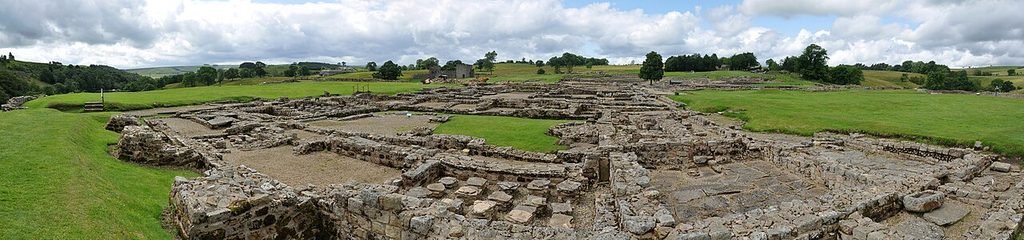

The site photograph provides geographical context, not a view of Severa’s birthday gathering. The reconstruction visible in the distance is modern. Archaeological views require the same care as written evidence: what survives or has been rebuilt today should not automatically become the scenery of an earlier event.
Ink on wood, and the work of keeping in touch
Vindolanda preserves different writing technologies. Ink tablets used thin wooden sheets as a writing surface. Stylus tablets instead held wax in a recessed wooden board; writing could be erased and the surface reused. The birthday invitation belongs to the ink-tablet tradition. [2]
Enos and Robinson approach the invitation as persuasion operating in ordinary social life. Severa is asking someone to act: to come and make an occasion happier through her presence. Their analysis highlights how a familiar letter form can carry both a request and an expression of attachment. Such a reading offers an interpretation of the language, rather than access to the sender’s private thoughts. [3]
For a reader today, the object is a reminder that relationships require practical work. Someone had to prepare this brief message, address it, and arrange for it to reach the recipient. The wooden sheet makes that otherwise easily forgotten act visible.
How did fragile wood survive?
The Vindolanda Trust attributes the remarkable preservation of organic material in the early levels to oxygen-poor conditions. Repeated rebuilding helped create them: demolished structures were covered with clay and turf, sealing earlier deposits. Wood, leather, and textiles survived in these protected layers far better than in the site’s more oxygenated upper deposits. Excavation then brought a new challenge, requiring conservation to keep vulnerable finds stable. [5]
That survival is selective. The letters available to historians reflect both what people once wrote and what their burial environment allowed to last. Absence from this surviving collection cannot, on its own, establish that a person never corresponded or that a kind of writing never existed.
Patricia Birley’s account of the first tablet discovery describes another obstacle: seeing the ink. On 23 March 1973, excavators noticed marks on a thin wooden fragment. By the time it was examined at Durham, the surface looked almost black. Infrared photography by Alison Rutherford subsequently revealed the writing. This episode concerns the first tablets discovered at Vindolanda; the birthday invitation itself was found in 1985. [7] [1]
Read the small evidence closely
The birthday invitation rewards attention to modest details: a named recipient, a day in September, a change of handwriting. Its value grows when we connect the wording to the physical object and compare it with other surviving letters. To explore it further, open the scholarly edition of tablet 291 below and compare its translation with the notes identifying the two hands. The gaps are part of the history, too.
Sources and further reading
- Roman Inscriptions of Britain. Tab.Vindol. 291. Birthday Invitation of Sulpicia Lepidina. Scholarly edition, translation, commentary, find details, and dating. Read source
- The Vindolanda Trust. Writing tablets. Updated 13 November 2024. Read source
- Richard Leo Enos and Natasha Trace Robinson. Claudia Severa’s Birthday Invitation: A Rhetorical Analysis of the Earliest Artifact of Latin Written by a Woman’s Hand. 2016. Peitho 18.2, pp. 4–24. Used for discussion of authorship, handwriting, and rhetorical interpretation; its broader historical claims are not adopted wholesale. Read source
- Roman Inscriptions of Britain. Tab.Vindol. 292. Correspondence of Sulpicia Lepidina. Scholarly edition, translation, and commentary on a separate letter. Read source
- Barbara Birley, The Vindolanda Trust. Why are the artefacts at Vindolanda found in such good condition? 13 March 2019. Read source
- Barbara Birley, The Vindolanda Trust. Why is Vindolanda to the south of Hadrian’s Wall? 13 March 2019. Read source
- Patricia Birley, The Vindolanda Trust. Finding the first Vindolanda Writing Tablet: A personal recollection. 10 March 2023; updated 23 March 2023. Read source
- The Vindolanda Trust. Evidence of Roman Women. Read source