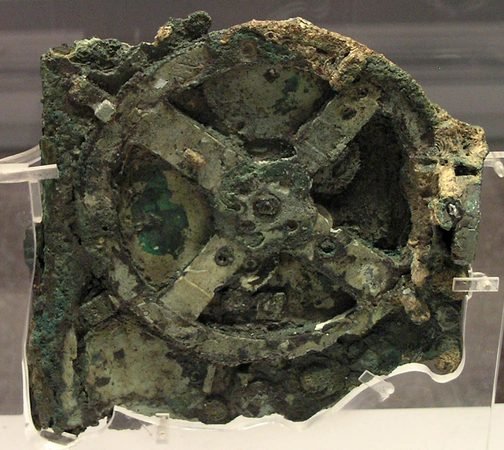
Recovered from a Mediterranean shipwreck, this ancient Greek machine turned astronomical cycles into moving gears. Its surviving fragments reveal both an extraordinary achievement and the limits of what we can reconstruct.
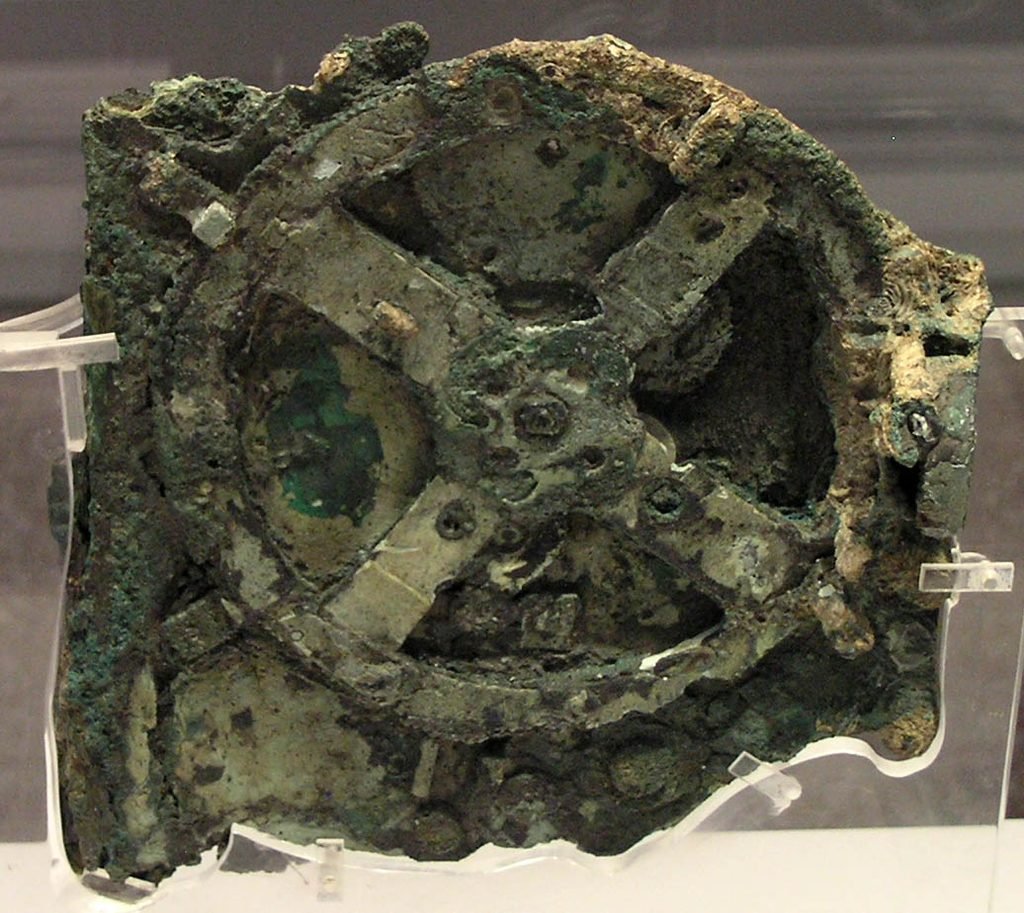

The most revealing feature of the Antikythera mechanism is a row of teeth. Even through the corrosion, their regular spacing is unmistakable: someone cut them so that one wheel would engage another. Behind those small teeth lay an ambitious idea. The movements of the heavens could be represented by the movements of a machine. [3]
The National Archaeological Museum in Athens dates the instrument to around 150–100 BC. More than two thousand years later, its damaged remains still preserve evidence of a world in which mathematical astronomy and skilled metalworking could meet inside a portable device. The precise date of its manufacture remains a question of scholarship; the museum’s range is a useful starting point, rather than a known year of construction. [1]
A shipwreck preserved the evidence
The wreck that gave the mechanism its name was discovered by sponge divers off the Greek island of Antikythera in 1900. Its cargo included bronze and marble sculptures, jewelry, furniture and fine glassware. The mechanism was recovered in 1901. The ship itself sank around 70–60 BC, several decades after the date range commonly assigned to the instrument. [2] [3]
Recovery came at a severe human cost. Working at a site about 55 meters deep, the early divers faced conditions that killed one man and left two others paralyzed, according to the Woods Hole Oceanographic Institution. The celebrated object belongs within that history of difficult underwater work. Its survival as an archaeological find depended on people who risked far more than a routine descent. [2]
How bronze could calculate
Calling the mechanism an analogue computer describes what its moving parts accomplished. Rotations represented quantities, while connected gears imposed mathematical relationships between them. Turning an input could advance several displays together, allowing the user to explore a modeled sequence of astronomical events. The calculation was built into the arrangement of the metal. [8]
One of its most sophisticated features concerned the Moon. Seen from Earth, the Moon does not move across the sky at a perfectly uniform speed. In 2006, researchers identified a mechanical representation of that irregularity in the surviving gearwork, connecting the instrument to the lunar theory developed by Hipparchus in the second century BC. Its makers had taken a subtle astronomical problem and given it a physical solution. [3]
The instrument also records an exchange of knowledge. Its eclipse calculations drew on Babylonian astronomical cycles, while its treatment of lunar motion incorporated Greek mathematical theory. It brought these traditions together in metal, turning inherited patterns and theoretical models into coordinated movement. [6]
Reading a machine that cannot be opened
Much of the evidence is concealed inside the corroded fragments. Imaging work carried out in 2005 combined detailed surface examination with X-ray computed tomography, revealing internal structures and inscriptions that ordinary photographs could not adequately show. Those scans allowed researchers to study the mechanism layer by layer without dismantling its fragile remains. [4]
The process also illustrates how archaeological knowledge improves. A study published in 2018 reprocessed the earlier X-ray data and produced clearer images of the largest fragment. Some previously uncertain characters became easier to read, and readings of eclipse times could be corrected. A single letter mattered because the inscriptions encoded numbers as well as words: better visibility could change the reconstruction of a calculation. [4]
A calendar for the heavens and for human life
The back of the instrument connected different ways of measuring time. Research published in 2008 identified an upper dial arranged as a five-turn spiral and based on the 19-year Metonic calendar cycle. A smaller dial tracked the four-year Olympiad cycle and the associated Panhellenic games. The machine placed public events alongside recurring patterns in the sky. [5]
That combination brings the artifact closer to the society that made it. An astronomical model could also be a way to organize a human calendar. Its dials joined different scales of experience: a changing Moon, a sequence of years, a recurring festival. The games display is a reminder that an ancient instrument could carry cultural meaning in the same tightly designed space as mathematical ingenuity. [5]
Predicting an eclipse with a repeating cycle
Another spiral dial addressed eclipses. It used the Saros, a cycle of 223 lunar months, to organize predictions of solar and lunar eclipses. Symbols within the dial’s month divisions recorded information such as the type of eclipse and its time. Associated inscriptions supplied further details. The user was consulting a mechanical expression of recurring astronomical patterns. [6]
The system had limits. Freeth’s 2014 analysis describes an impressive prediction scheme that was not entirely accurate. Its achievement should be judged in those terms: ancient observers and mathematicians had recognized patterns sufficiently regular to be embodied in a calculating instrument. Forecasting an event in the sky no longer required waiting for it to happen; selected relationships could be consulted through a dial.

The missing front remains a research problem
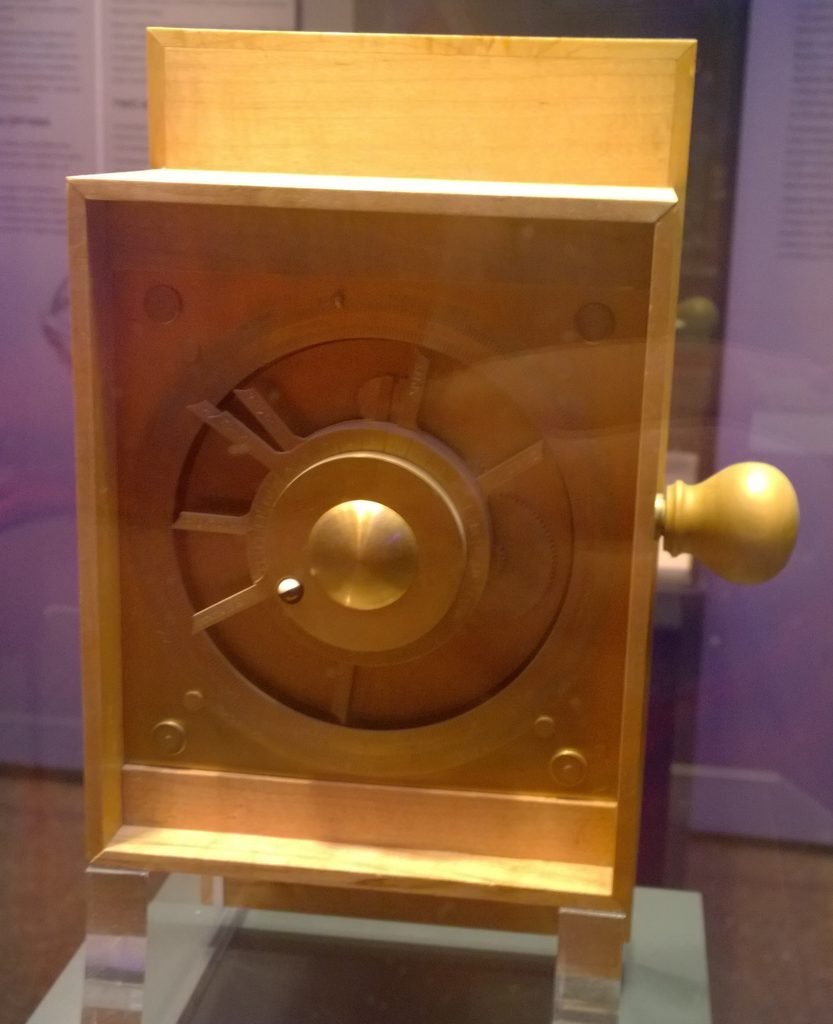
The surviving material is incomplete. UCL’s account of its 2021 research describes roughly a third of the mechanism remaining, divided into 82 fragments, with 30 surviving bronze gears. Much of the front display is missing, making its detailed reconstruction particularly difficult. [7]
In a 2021 paper, a team led by Tony Freeth proposed a model for this lost system that integrated the Sun, Moon and the five planets known in antiquity. The researchers combined the physical evidence with inscriptions and astronomical period relations. Their proposed gearing offered a way to fit a complex representation of the ancient cosmos into a restricted space. [8]
A reconstruction, however, remains an argument about missing material. Its components must be tested against the fragments, the texts and the practical constraints of manufacture. UCL’s announcement explicitly identified construction with ancient techniques as a further challenge. A compelling model can advance understanding while leaving room for another discovery to change the design. [7]
The people behind the gears
The mechanism sits within a wider ancient interest in representing the heavens mechanically. Freeth and Alexander Jones discuss Cicero’s account of an astronomical device associated with the philosopher Posidonius. Such testimony supplies a historical setting for this kind of work, although it does not identify the maker of the instrument recovered at Antikythera. [9]
The surviving machine invites us to consider the work that a finished object conceals: observing, comparing periods, choosing ratios, shaping teeth and making parts cooperate. The fragmentary evidence does not let us assign every task to a named person. It does let us recognize the meeting of intellectual and practical skill.
That may be the most enduring reason to look closely at the bronze. Someone once understood enough about the sky, and enough about making things, to connect the two. The instrument is broken. The ambition behind it remains legible.
SOURCES & FURTHER READING
[1] National Archaeological Museum, Athens. Museum brochure, Collection of Metalwork: Antikythera Mechanism, dated 150–100 BC.
https://www.namuseum.gr/wp-content/uploads/2022/03/nam-brochure-%CE%95%CE%9D-low.pdf
[2] Woods Hole Oceanographic Institution (2014). Stunning Finds from Ancient Greek Shipwreck.
https://www.whoi.edu/press-room/news-release/antikythera-finds/
[3] Freeth, T., et al. (2006). Decoding the ancient Greek astronomical calculator known as the Antikythera Mechanism. Nature 444, 587–591.
https://doi.org/10.1038/nature05357
[4] Pakzad, A., et al. (2018). Improved X-ray computed tomography reconstruction of the largest fragment of the Antikythera Mechanism, an ancient Greek astronomical calculator. PLOS ONE 13(11), e0207430.
https://doi.org/10.1371/journal.pone.0207430
[5] Freeth, T., Jones, A., Steele, J. M., and Bitsakis, Y. (2008). Calendars with Olympiad display and eclipse prediction on the Antikythera Mechanism. Nature 454, 614–617.
https://doi.org/10.1038/nature07130
[6] Freeth, T. (2014). Eclipse Prediction on the Ancient Greek Astronomical Calculating Machine Known as the Antikythera Mechanism. PLOS ONE 9(7), e103275.
https://doi.org/10.1371/journal.pone.0103275
[7] University College London (2021). Experts recreate a mechanical Cosmos for the world’s first computer.
https://www.ucl.ac.uk/news/2021/mar/experts-recreate-mechanical-cosmos-worlds-first-computer
[8] Freeth, T., et al. (2021). A Model of the Cosmos in the ancient Greek Antikythera Mechanism. Scientific Reports 11, 5821.
https://doi.org/10.1038/s41598-021-84310-w
[9] Freeth, T., and Jones, A. (2012). The Cosmos in the Antikythera Mechanism. ISAW Papers 4.
https://dlib.nyu.edu/awdl/isaw/isaw-papers/4/