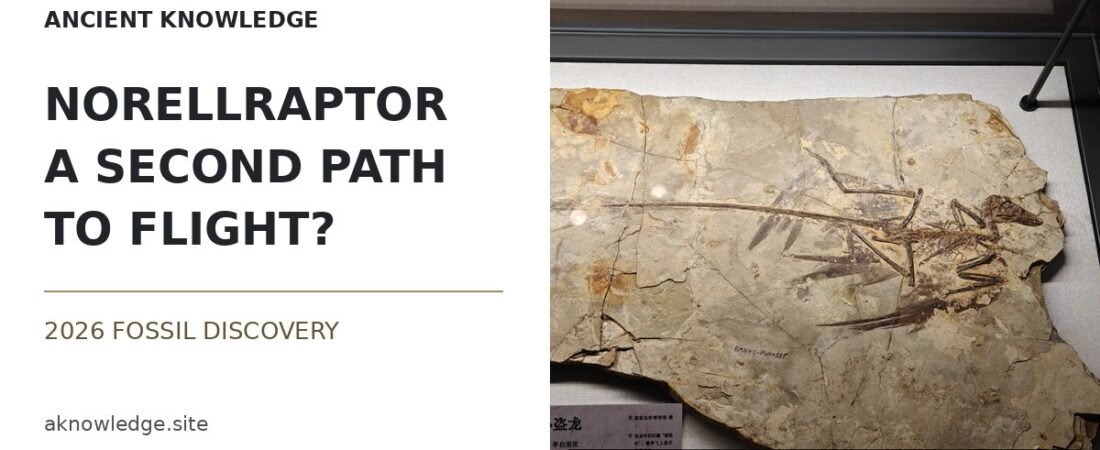
A small skeleton preserved in stone has made the history of flight more complicated. Named Norellraptor barsboldi, the 57-centimeter dinosaur was found in northeastern China with a nearly complete skeleton and traces of plumage beside its forelimbs, hindlimbs and tail. It was not a bird, and the new study does not demonstrate that this individual could sustain powered flight. What it does show is that a close bird relative carried a striking collection of flight-related features assembled in an evolutionary sequence different from the one reconstructed for early birds. The fossil therefore strengthens a fascinating possibility: dinosaur flight may not have followed one simple path. [1] [2]
A fossil found near Lamadong
The specimen came from near Lamadong Town in Jianchang County, western Liaoning Province. A local farmer discovered it and donated it to the Museum of Hebei GEO University in 2023. Researchers checked the fossil’s provenance and integrity before describing it. Its museum number is 130108-MHGU-F4281, and it is the holotype: the single reference specimen on which the new genus and species are formally based. The team published the description in Nature Communications on September 29, 2026. [1]
Norellraptor came from the Jiufotang Formation, one of the fossil-rich rock units associated with the Jehol Biota. Recent dating places the formation broadly between about 124.4 and 112.3 million years ago, during the Early Cretaceous. The paper identifies the fossil’s formation and locality but does not assign the specimen to one precisely dated ash layer, so a narrower age would imply more certainty than the evidence allows. [1] [5]
.jpg)
What the skeleton preserves
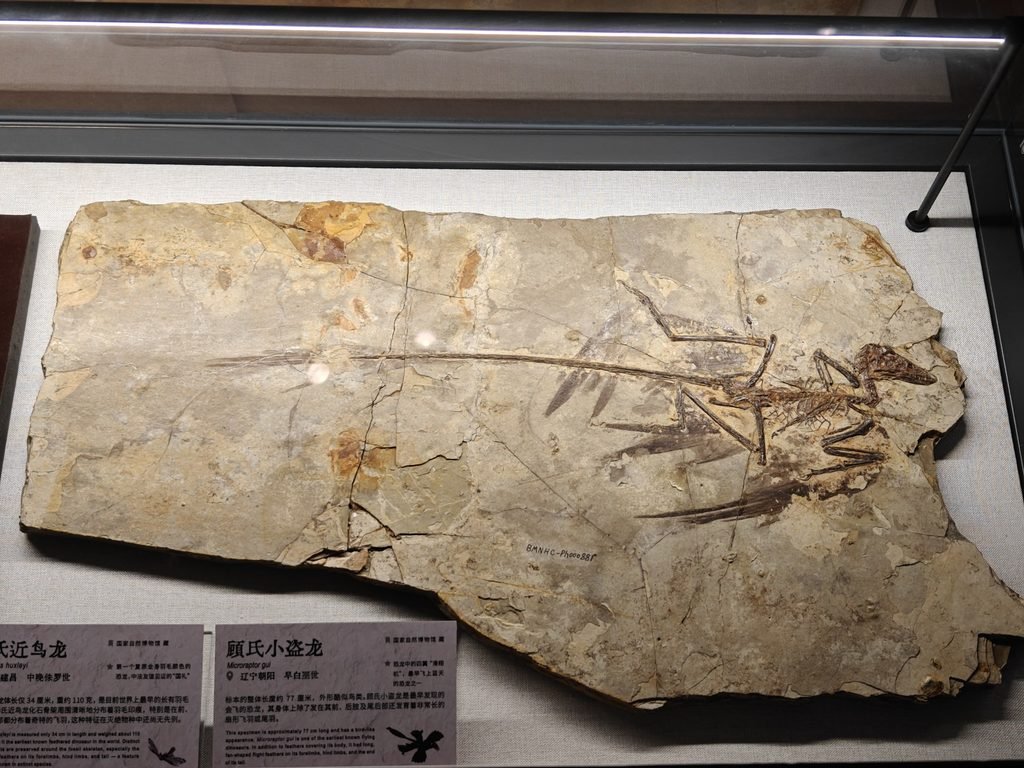
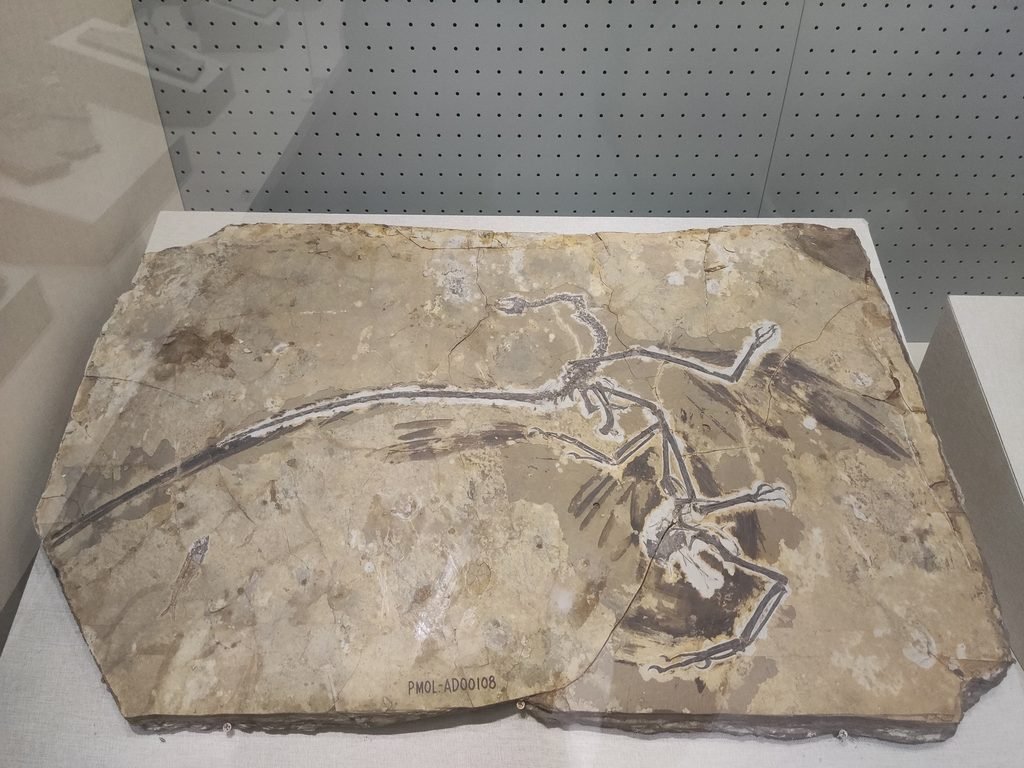
The skeleton is complete, although parts of the shoulder and hip regions shifted after death. The skull, long tail, limbs and much of the torso remain visible. The researchers identified Norellraptor as a microraptorine dromaeosaurid – a small, feathered member of the wider raptor family and a close relative of birds, but not a bird itself. Features of the skull, wrist, pelvis and feet distinguish it from Microraptor, Changyuraptor, Wulong and other named members of the group. [1]
Traces of plumage occur beside the right upper arm, near the hips, below the base and end of the tail, and beside the lower hindlimb and foot. Feathers near the hand were probably asymmetrical pennaceous feathers, a form associated with aerodynamic function in living birds. Yet the paper is explicit about the limit of the evidence: preservation is not good enough to reconstruct the original length and detailed shape of the plumage. Calling Norellraptor a ‘four-winged dinosaur’ is useful shorthand for its microraptorine body plan, not proof that four fully reconstructed wings are visible on the slab. [1]
Why the so-called four wings matter
Some microraptorines carried long flight feathers on both the arms and legs, producing four wing-like surfaces as well as an aerodynamic tail. This arrangement has no exact living equivalent. It gave paleontologists a rare natural experiment: a dinosaur could use aerodynamic surfaces distributed across the body rather than concentrating most lift and control in two forewings, as modern birds do. [4] [6]
A separate 2026 study used computer models to examine Microraptor, a close relative rather than Norellraptor itself. The simulations found useful interactions between the forewing and hindwing during gliding, including vortex patterns that could add lift. That work helps explain why a multiwinged body could be functional. It cannot be transferred automatically to Norellraptor because the new fossil does not preserve enough feather geometry for the same aerodynamic test. [4]

Fifty-seven similarities, but not the same sequence
The most important result did not come from a single dramatic bone. The researchers added Norellraptor to a large anatomical family tree and traced how features changed along microraptorine and avialan branches. Avialans are the lineage that includes birds and their closest extinct relatives. The analysis reconstructed 194 anatomical changes within microraptorine evolution. Fifty-seven of them – about 30 percent – also appeared along the avialan lineage. [1]
Those overlapping features include changes to the breastbone and ribs, stronger forelimbs relative to the hindlimbs, wrist fusion, a reduced first finger and several modifications of the pelvis and feet. Similar structures can evolve independently when different animals face comparable functional pressures. This process is called convergent evolution. The question was whether the two lineages merely ended with similar equipment or followed the same hidden developmental route while building it. [1]
According to the study, they did not. The order in which the shared traits appeared was not significantly correlated between microraptorines and avialans. The authors therefore argue that the two groups assembled their flight-related anatomy under different selective regimes. In plain language, evolution appears to have reached partly similar solutions by taking different routes. That supports multiple experiments with aerial locomotion among bird-like dinosaurs rather than one tidy progression from ground-running dinosaur to modern bird. [1] [2]
Did Norellraptor actually fly?
The honest answer is that the fossil does not settle the question. Its anatomy and probable asymmetrical feathers are consistent with aerial adaptation, and other microraptorines are strong candidates for gliding or some form of powered flight. But the 2026 Norellraptor paper is chiefly an anatomical, histological and evolutionary analysis. It does not reconstruct this animal’s complete wing outline, calculate its lift, or test how it launched and landed. [1] [4] [7]
This distinction matters because ‘flight’ can describe different behaviors. Controlled descent, gliding between trees, wing-assisted leaps and sustained flapping flight place different demands on the skeleton and feathers. A fossil may preserve evidence compatible with one or more of those behaviors without recording the behavior itself. Norellraptor adds anatomical evidence to the debate; it is not a frozen photograph of the animal in the air. [1] [4]
A dinosaur at least three years old
The researchers cut and examined a tiny cross-section from the radius, one of the forearm bones. Two clear lines of arrested growth and the beginning of a third growth zone suggest that the animal was at least three years old when it died. Its bones also show fused elements in the lower leg and foot, but the histology indicates that growth had not fully ended. The authors interpret the specimen as a late juvenile that died soon after growth resumed for another season. [1]
The forearm’s microscopic structure may also point to an unusual growth pattern. The authors tentatively propose that microraptorine forelimbs and hindlimbs matured under a regime unlike that of modern flying birds. That interpretation is intriguing, but it rests on a limited fossil sample and needs more comparable bones from animals of different ages. [1]
What one specimen cannot tell us
Norellraptor is known from one individual. The fossil does not reveal the species’ color, sex, diet, social behavior or full geographic range. Its preserved feather traces do not provide a complete aerodynamic surface, and its exact position inside the Jiufotang time span remains broad. Even the evolutionary tree is a testable hypothesis: adding new species or recoding uncertain anatomy can change relationships and the inferred order of trait evolution. [1] [3]
The study’s strongest claim is therefore narrower than many headlines suggest. It does not show that birds evolved from Norellraptor, that every feathered dinosaur could fly, or that flight originated exactly twice. It shows that one newly described microraptorine fits a pattern in which many bird-like flight traits arose convergently and in a different sequence from the avialan branch. That makes repeated evolutionary experimentation more plausible, while leaving the number and nature of those experiments open. [1] [2] [3]
Why Norellraptor matters
The origin of flight is often presented as a ladder: feathers appeared, forelimbs became wings, and birds took off. Norellraptor favors a messier and more interesting picture. Early bird relatives explored several combinations of feathers, limbs, growth patterns and skeletal reinforcement. Some combinations disappeared; one branch eventually produced the living birds around us. The new fossil matters not because it supplies a final answer, but because it preserves another route evolution tested on the way into the air. [1] [3]
Follow Ancient Knowledge for evidence-based reports that separate what fossils preserve from what scientists infer – and what remains unknown.
Sources and further reading
- Nature Communications. Independent assembly of the flight apparatus in a non-avian dinosaur clade. September 29, 2026. Peer-reviewed description of Norellraptor barsboldi, its anatomy, bone histology and phylogenetic analysis. Read source
- Nature Portfolio. Palaeontology: A new feathered dinosaur from China. September 30, 2026. Publisher’s research summary and cautious account of the study’s conclusions. Read source
- Nature. Stunning fossil shows dinosaurs’ distinctive path to flight. October 2, 2026. Independent science-news coverage of the fossil and the debate over repeated origins of flight. Read source
- Proceedings of the National Academy of Sciences. Microraptor reveals specialized gliding capabilities in multiwinged early paravians. January 26, 2026. Aerodynamic modeling of a related microraptorine; it is comparative evidence, not a flight test of Norellraptor. Read source
- Earth and Planetary Science Letters. High-precision geochronology of the Early Cretaceous Jiufotang Formation: Temporal constraints on the late phase of the Jehol Biota. 2025. Refines the Jiufotang Formation’s age span to approximately 124.44-112.25 million years ago. Read source
- Nature. Four-winged dinosaurs from China. January 23, 2003. Foundational description of long feathers on the forelimbs and hindlimbs of Microraptor gui. Read source
- Current Biology. Potential for powered flight neared by most close avialan relatives, but few crossed its thresholds. October 5, 2020. Comparative analysis of flight potential among early birds and close relatives. Read source