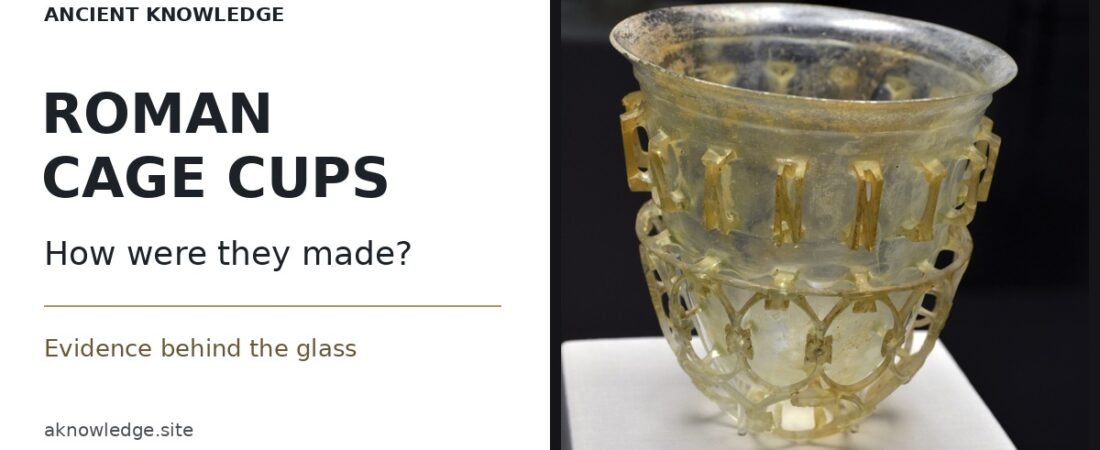
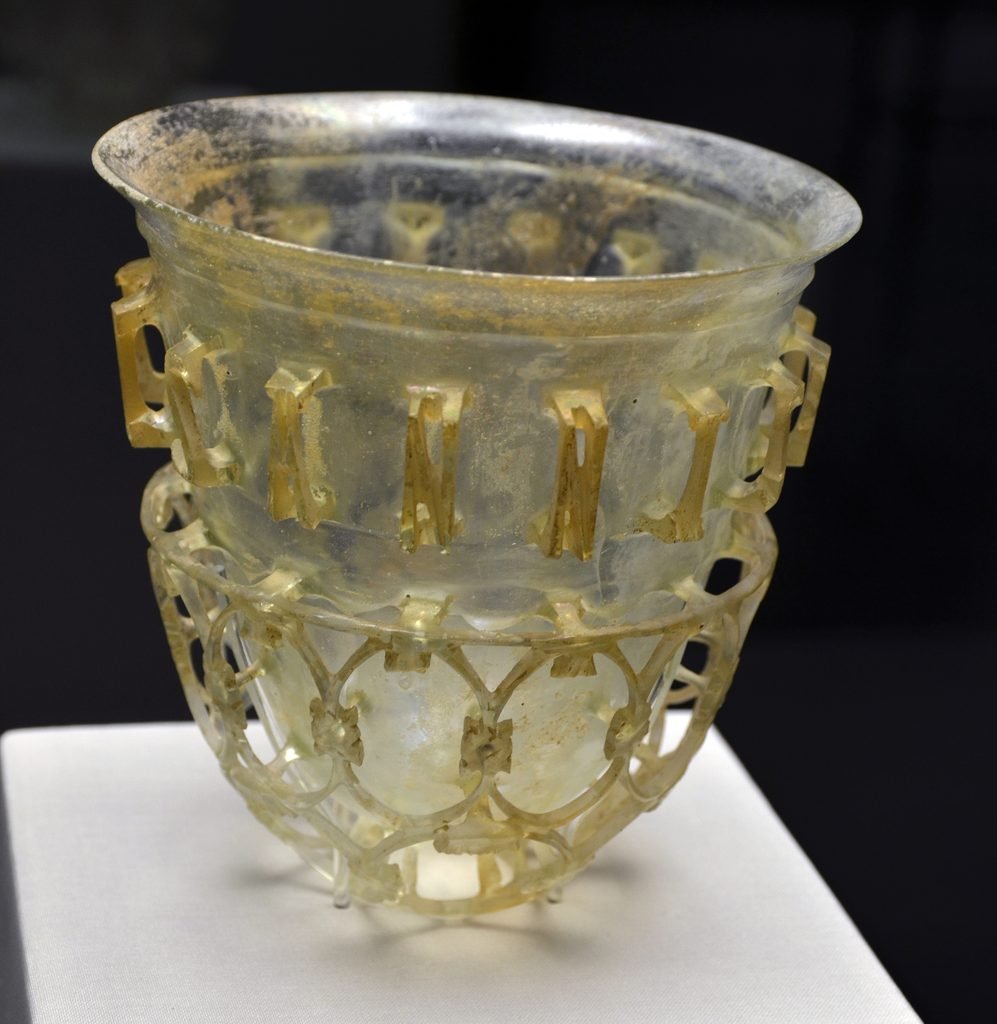

Look closely at a Roman cage cup and the puzzle appears in the gaps. An outer network seems to float around the vessel, connected to it by tiny glass bridges. How could anyone carve behind that network without breaking it? The strongest evidence from studied examples points to cutting and grinding a thick glass blank, gradually exposing the cage while leaving its supports in place. Unfinished fragments and manufacturing traces make this more than an attractive theory. They also reveal why a successful modern replica cannot, by itself, settle every question about an ancient workshop. [1] [3] [4]
What makes a glass vessel a cage cup?
Cage cups are also called diatreta, or vasa diatreta. Their defining feature is openwork decoration standing away from the vessel’s body, with small struts connecting the two. Those struts matter: they explain how the apparently separate outer shell remains attached. The striking effect comes from the relationship between solid glass, open space, and narrow points of support. [1]
The Munich cup pictured here makes that structure unusually easy to see. Below its projecting letters, loops of glass surround the inner vessel. The Staatliche Antikensammlungen dates this cup, found in Cologne, to AD 300–350. Its appearance is a useful starting point, but looking at a finished object cannot reveal every stage of its manufacture. [9]
Not every cage followed a repeating geometric pattern. The Kelsey Museum distinguishes these networks from vessels whose cut decoration forms figures. In either case, the technical problem includes working beneath the raised design while preserving the connections to the wall behind it. The shape of that hidden space is as important as the decoration facing the viewer. [2]
How were Roman cage cups made?
The cutting model begins with extra thickness. Instead of attaching a finished network to a thin drinking glass, the worker removes material from a substantial blank. Selected glass remains as the vessel wall, the outer decoration, and the bridges between them. The Kelsey Museum places this work within Roman cold decoration: cooled glass could be worked with abrasive-fed wheels, much as a hard stone could be cut. [2]
A modern demonstration makes the sequence easier to follow. George D. Scott’s Cage Cup in Stages, made in Edinburgh in 1988–1989 and held at Corning, includes a blank, a marked-out form, an unfinished cage, and a completed replica. These are modern experimental objects, not Roman workshop remains. [5]
First, enough glass is provided for both the inner vessel and the future cage. Next, the pattern is laid out: Scott’s marked blank carries guidelines and drawn outlines. Cutting then opens the spaces within the design. In the unfinished stage, some openings reach full depth while parts of the network remain only partly undercut. Further work releases the decoration from the body while retaining the supporting bridges. [5]
Scott’s sequence shows a practical route from a heavy blank to delicate openwork. It does not establish that Roman craftspeople used his marking materials or followed every operation in the same order. Its value is experimental: a proposed method produces the required structure. To connect that method to antiquity, researchers need traces on ancient glass itself.
The unfinished cup that preserved a manufacturing clue
Fragments from the excavation of the early Christian church of Saint-Laurent in Grenoble offered an especially useful test. The vessel had broken before its manufacture was finished. That interruption preserved evidence a completed surface might conceal or remove. [3]
In the published abstract of her 2011 study, Marylen Kappes describes comparing the network’s upper edge, the positions of its bridges, and its surface textures against competing manufacturing explanations. Her conclusion was specific: the Grenoble vessel had been made by grinding a thick-walled blank. The result supported the route explored in Josef Welzel’s experiments. [3]
This is a stronger argument than saying that a cup looks carved. Several features must fit the proposed process together. It is also a properly limited conclusion. Evidence for the Grenoble vessel establishes how that example was worked; extending the result to every surviving cage cup requires further comparison.
What restoration and broken surfaces can reveal
The early fourth-century AD cup from Taraneš provides another case. In a 2017 study, Katja Broschat, Susanne Greiff, and Mila Surbanoska reported manufacturing traces documented during conservation that indicated cutting and grinding a thick-walled blown blank. The work also changed the reconstructed arrangement of the inscription band and frieze. Restoration therefore helped reassess both manufacture and the vessel’s appearance. [4]
A smaller fragment at the Metropolitan Museum of Art makes the underlying structure visible. Dating to the late third–fourth century AD, it preserves figural relief supported by five bridges. The Met estimates from its rim curvature that it belonged to a bowl about 18 centimeters across. The surviving piece is not a miniature complete cup: it is part of a larger vessel. [6]
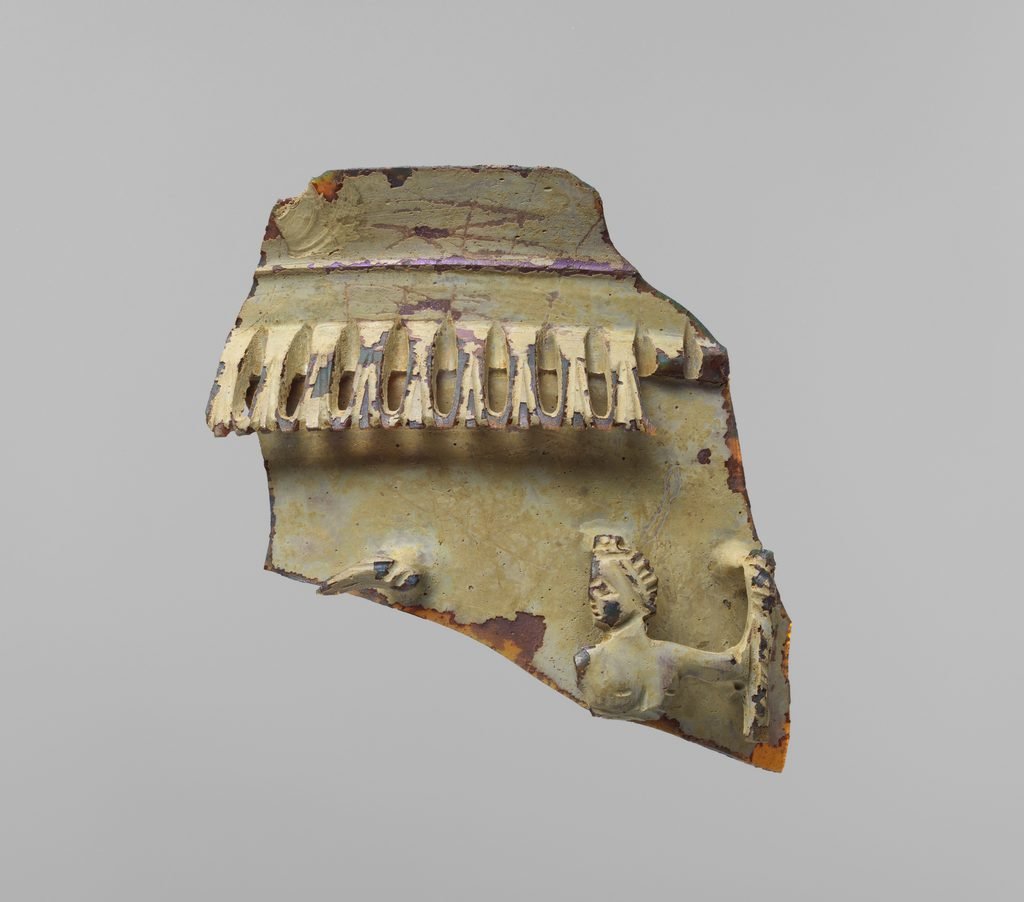
For a reader examining museum photographs, that distinction matters. A fragment can expose connections that are difficult to follow in an intact vessel. It cannot independently supply the missing vessel’s complete design. A reconstruction must therefore distinguish what survives from what has been inferred.
Blowing, casting, and cutting are different questions
A label describing glass as blown or cast need not contradict evidence that it was cut. Forming the starting blank and carving the openwork are different stages. The Met records its fragment as blown or cast and cut, leaving the first stage unresolved. Corning likewise lists its ancient cage cup, accession 87.1.1, as cast or blown and wheel-cut. Neither catalogue treats uncertainty about forming the blank as uncertainty about every later operation. [6] [8]
Color adds another challenge. Anastasia Cholakova and colleagues analyzed fragments from two Bulgarian cage cups, finding different glass compositions in their colorless bodies and colored elements. Their published abstract suggests that some colored glasses were made by adding colorants to the base glass, an approach potentially helpful for compatibility and controlled cooling before elaborate cold working. The finding concerns preparation of the material as well as carving it. [7]
Were all cage cups drinking vessels?
The word cup can hide a separate question about use. Corning’s example, probably dating to AD 300–399, retains a metal collar that indicates suspension. The museum interprets it as a probable hanging lamp. That interpretation should retain its qualification, and it should not be transferred automatically to other vessels. The Munich museum, for example, describes its own cage cup as a drinking vessel. [8] [9]
Manufacture, shape, and function need related but different evidence. A looped network explains the name cage cup; it does not, on its own, prove what the object held or where it was displayed. Attachments, inscriptions, find context, and surviving residues may answer different parts of that larger question.
The skill is clearer when we follow the evidence
The useful answer is neither complete certainty about every workshop nor a claim that Roman cage cups are inexplicable. Cutting and grinding have strong support in the examples studied here. Questions about individual blanks, exact working sequences, and workshop practice still require object-specific evidence. [3] [4]
Next time you see a cage cup, look past its pattern. Follow a bridge from the outer decoration to the inner wall, then ask what evidence supports the museum’s account of its manufacture. Read a catalogue entry linked below and compare a surviving object with an experimental reconstruction. That distinction makes the achievement easier to understand—and gives the ancient craftsperson’s decisions the attention they deserve.
Sources and further reading
[1] The Corning Museum of Glass. Cage cup. Glass Dictionary definition. Read source
[2] Kelsey Museum of Archaeology, University of Michigan. Wondrous Glass: Decorative Techniques of Roman Glass. Read source
[3] Marylen Kappes / The Corning Museum of Glass. Fragments of a Cage Cup from Grenoble: Technological Elements. 2011. Journal of Glass Studies 53, starting p. 93. English abstract of the French article consulted. Read source
[4] Katja Broschat, Susanne Greiff, and Mila Surbanoska / The Corning Museum of Glass. The Taraneš Cup: New Information on an Old Find. 2017. Journal of Glass Studies 59, starting p. 101. Published abstract consulted. Read source
[5] The Corning Museum of Glass. Cage Cup in Stages. Object 89.2.22. Modern replicas by George D. Scott, Edinburgh, 1988–1989. Read source
[6] The Metropolitan Museum of Art. Glass cage cup fragment. Object 26.60.95. Read source
[7] Anastasia Cholakova, Thilo Rehren, Bernard Gratuze, and James Lankton / The Corning Museum of Glass. Glass Coloring Technologies of Late Roman Cage Cups: Two Examples from Bulgaria. 2017. Journal of Glass Studies 59, starting p. 117. Published abstract consulted. Read source
[8] The Corning Museum of Glass. Cage Cup. Object 87.1.1. Read source
[9] Staatliche Antikensammlungen und Glyptothek, Munich. Unsere Meisterwerke: Diatretglas. Official collection overview; cup from Cologne, AD 300–350. Read source
Sources and image rights checked on 27 September 2026.