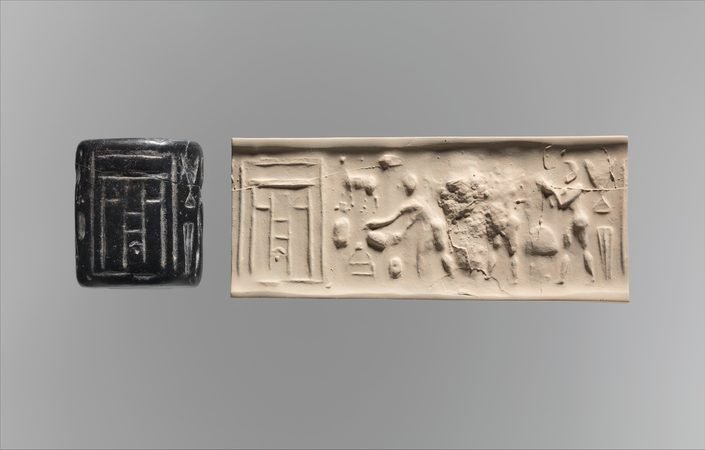
A stone cylinder smaller than a person’s thumb could produce an image far wider than itself. Pressed into wet clay and rolled once, its tiny carvings became a continuous scene: people, animals, buildings, gods and, in later periods, written names. The result could help secure a jar, close a doorway or mark a tablet connected to a transaction. [1]
Mesopotamian cylinder seals were therefore more than miniature artworks. They were practical instruments of administration and markers of identity, office and authority. Some also functioned as jewelry or amulets. Their exact meaning changed across places and centuries, so calling them simply “ancient signatures” captures only part of the story. [2] [3]
A picture designed to move
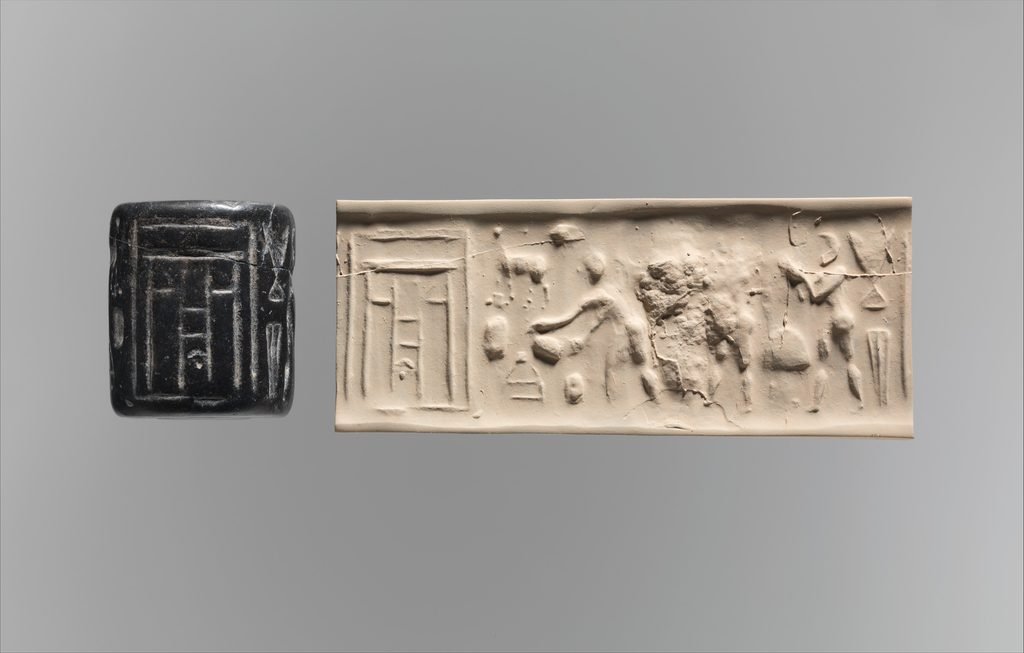
A cylinder seal worked through rotation. A seal cutter engraved the design into the curved surface in intaglio, cutting the image below the stone’s surface. When the cylinder was rolled across soft clay, the recessed design produced a raised and readable impression. One turn transformed a compact object into an extended composition. [1] [8]
This is why museum photographs often place a seal beside a long strip of clay. The strip is usually a modern impression made to reveal the full design; it is not necessarily an ancient sealing found with the object. The Metropolitan Museum of Art states this explicitly for its Late Uruk seal showing a procession toward a temple facade, dated to about 3500–3100 BC. [1]
The method offered something a stamp seal could not: more surface area for a complex image without making the object unwieldy. Cylinder seals appeared in the fourth millennium BC in Mesopotamia and spread into other parts of West Asia. They remained in use for long periods, but their forms, materials and social roles were never identical everywhere. [1] [2]
What did cylinder seals actually seal?
Clay was the key. A lump of wet clay could be placed over the fastening of a jar, basket or door. Rolling a seal across it created a distinctive image while the clay was still soft. If someone opened the container or entrance, the sealing would normally be broken or disturbed. The image did not make interference impossible; it made control and later checking more visible. [1] [3]
Seals were also rolled onto tablets associated with commercial, administrative and legal business. Depending on the period and context, an impression could identify a participant, witness, official or institution. It could signal that someone had supervised, acknowledged or authorized an action. The function has to be reconstructed from the document and archaeological setting, not from the picture alone. [1] [3] [8]
Identity, but not a modern signature
The Institute for the Study of Ancient Cultures describes cylinder seals as conveying the identity of individuals or of an office, including social, administrative and religious identities. That is more precise than imagining every seal as a personal autograph. Some belonged to private people; others represented positions within an institution. Royal and official seals could express delegated authority as well as personal identity. [2] [3]
One Neo-Sumerian example at The Met names Ilum-bani, an overseer and servant of King Ibbi-Sin. Its inscription and presentation scene show a worshiper led by a goddess toward a deified king. The museum dates the hematite seal to about 2028–2004 BC and notes that this standardized type was associated with high officials below the king in the administrative hierarchy. [5]
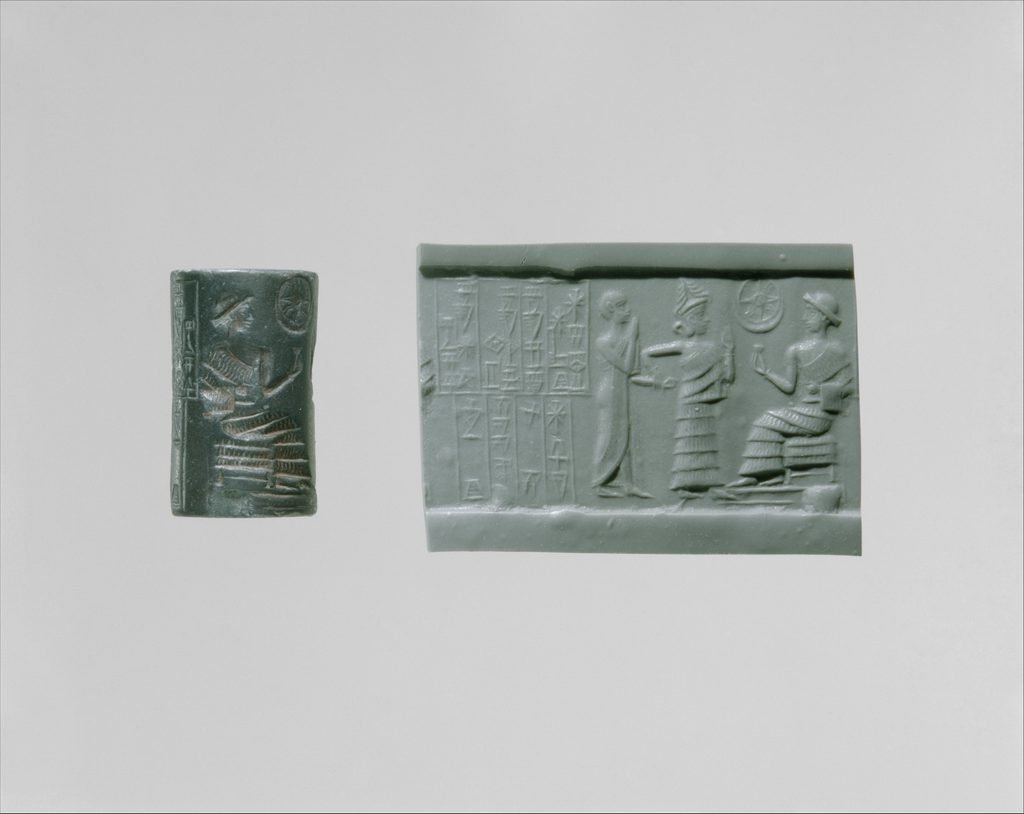
Even this unusually informative object is not a passport in stone. Its inscription, image and official formula worked within a specific political culture. A seal could be reassigned, recut, copied, lost or used by someone acting for an office. Modern comparisons with signatures, identity cards or passwords may help explain one function, but none reproduces the ancient system exactly. [3] [8]
Images could communicate power and protection
Cylinder seals carried images as well as administrative force. Early designs could show processions, buildings, animals, combat and ritual activity. Later seals might combine figures with inscriptions naming an owner, ruler, parent or office. The rolling surface turned these elements into a sequence that could be repeated whenever the seal was used. [1] [5] [6]
An Early Dynastic Sumerian seal at The Met, dated to about 2600–2350 BC, shows lions, bulls, a human-headed bull and a bearded hero locked in a dense contest scene. Such imagery was not decoration detached from use: the same scene became the visible mark impressed into clay. Yet its precise message to the original owner cannot be reduced to a single modern caption. [6] [8]
Materials and images could also carry protective value. Museums describe some seals as amulets as well as markers of ownership or identification. Hard and visually striking stones—including limestone, marble, hematite and lapis lazuli—made the object durable and personally significant. ISAC also notes that seals could be worn as jewelry. [1] [2] [7]
Seals and writing developed together
Cylinder seals belong to the same broad administrative world in which early writing developed, but one should not claim that a seal was simply a line of writing or that seals alone invented cuneiform. The two systems could operate together on the same piece of clay: one recorded information through signs and numbers, while the other contributed an image tied to authority or identity. [4] [7]
A proto-cuneiform tablet at The Met, dated to about 3100–2900 BC and probably from Uruk, makes the relationship visible. The tablet most likely concerns the distribution of grain by a large temple, although the museum stresses that the earliest texts can be difficult to interpret. A cylinder seal was rolled incompletely over both faces and the edges before the tablet was inscribed. The original seal has not survived. [4]
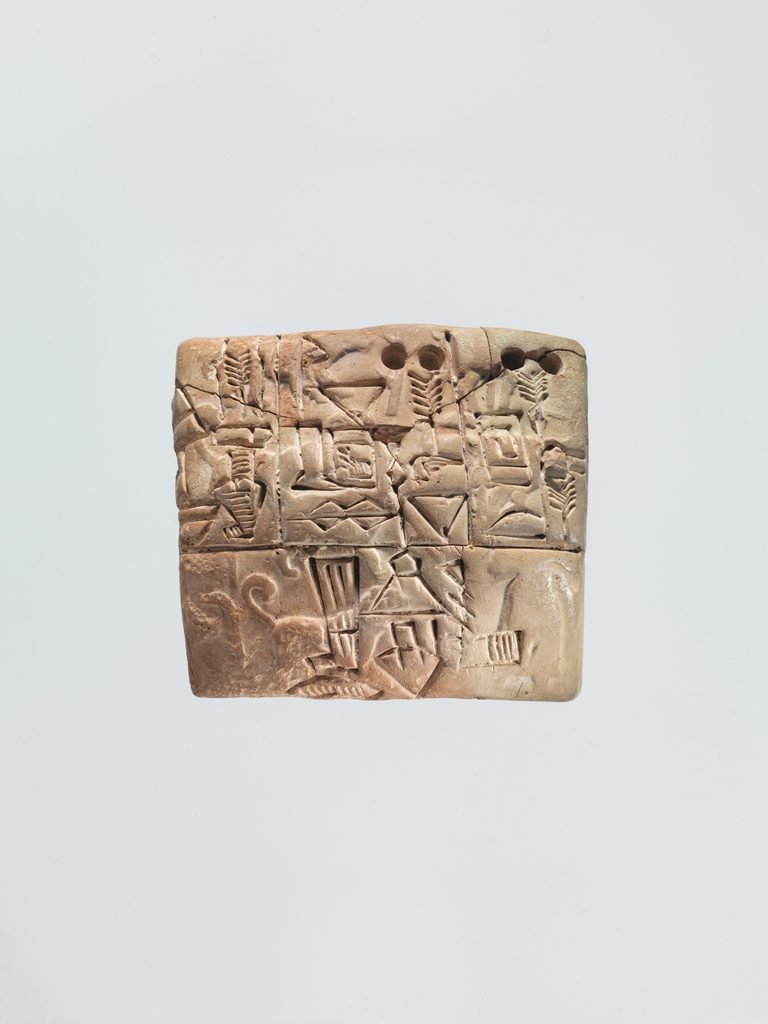
That missing seal is an important reminder. Archaeologists may recover the carved stone, the clay impression or both. An impression can preserve evidence for a seal that is otherwise lost, and repeated impressions can reveal patterns of administration. But without a secure excavation context, assigning a seal to a particular person, building or transaction becomes much harder. [3] [4]
How historians read a cylinder seal
Researchers combine several kinds of evidence. The stone and carving technique can suggest materials and workmanship. The style and iconography can be compared with excavated examples. An inscription may name an owner or ruler. A sealing attached to a tablet or container can reveal how the device was used. Stratigraphy and findspot help place it within a dated archaeological sequence. [5] [6] [7]
No single clue is infallible. Styles can continue or be revived; ancient seals could be reused; inscriptions may preserve formulaic language; and scenes can remain ambiguous. A modern rolling clarifies the design but does not reproduce every ancient use. Responsible interpretation therefore separates what the object shows from what scholars infer about ownership, belief or administration. [1] [3] [8]
Why such small objects mattered
Cylinder seals helped people manage trust in societies where goods, labor and written records moved through households, temples, palaces and workshops. They made authority visible in clay. At the same time, their materials and images connected daily administration with status, ritual and ideas of protection. [3] [7] [8]
That combination explains their historical value. A cylinder seal is both a tool and an image-bearing object; its impression is both physical evidence and a social act. To understand one properly, we must look at the carved stone, the clay it marked and the institution or person behind the mark. Explore the museum records below to compare the ancient objects with their modern impressions, and return to Ancient Knowledge for more evidence-based histories of the ancient world. [1] [4] [5]
Sources and further reading
- The Metropolitan Museum of Art. Cylinder seal and modern impression: ritual scene before a temple facade. Late Uruk, about 3500–3100 BC. Object 1983.314.1; function, materials and explanation that the displayed impression is modern. Read source
- Institute for the Study of Ancient Cultures, University of Chicago. Teacher Resources: Create Your Own Seals. Consulted 30 September 2026. Overview of chronology, geographical spread and identities represented by cylinder seals. Read source
- Oya Topçuoğlu, Oriental Institute of the University of Chicago. Seals in Mesopotamia. 2019. News & Notes 243, pp. 10–12; overview of official seals, identity and administrative practices. DOI 10.83354/gp6d-4057. Read source
- The Metropolitan Museum of Art. Proto-Cuneiform tablet with seal impressions: administrative account of barley distribution. Jemdet Nasr, about 3100–2900 BC. Object 1988.433.1; early writing and an ancient cylinder-seal impression on a tablet. Read source
- The Metropolitan Museum of Art. Cylinder seal: seated figure approached by a goddess leading a worshiper. Ur III, about 2028–2004 BC. Object 1988.380.2; Ilum-bani inscription, presentation scene and official context. Read source
- The Metropolitan Museum of Art. Cylinder seal and modern impression: bull-man, bearded hero, and lion contest frieze. Early Dynastic III, about 2600–2350 BC. Object 55.65.4; comparative evidence for contest imagery. Read source
- The Metropolitan Museum of Art. Cylinder seal, Old Babylonian. About 18th–16th century BC. Object X.304.13; seal as identification and amulet, with the god Amurru as a possible protective image. Read source
- Holly Pittman, Cambridge University Press. Administrative Role of Seal Imagery in the Early Bronze Age: Mesopotamian and Iranian Traders on the Plateau. 2018. Scholarly overview of seals as administrative tools, markers of identity, office, status and authority; cautions against fixed interpretations of imagery. Read source