.JPG)
A collapsed roof usually sounds like bad news for a burial chamber. At Vulci in central Italy, it helped protect parts of an Etruscan tomb through repeated looting. Archaeologists have now excavated three chambers containing pottery, metal objects and other burial goods, including vessels still in their original positions. [1]
The discovery, announced by Italy’s local archaeological authority on 22 September 2026, comes from the Polledrara necropolis. The newly excavated Etruscan tomb at Vulci belongs to the late seventh century BC and sits within a burial-mound complex identified in 1889. Its value lies in the surviving connections between objects, their placement and the people who arranged an elaborate burial around 2,600 years ago. [1]
What archaeologists found inside the tomb
The team calls the burial the Tomba della Camera di pietra, or Tomb of the Stone Chamber. Its principal chamber had retaining walls built from blocks of nenfro stone. The complex was cut into deposits left by a former course of the Fiora River. Archaeologists fully explored its three funerary chambers during the 2026 campaign. [1]
The official account lists pottery from Attica and Corinth alongside local ceramics, including decorated impasto and black bucchero ware. Other finds include weapons, chariot components, roasting spits, gold and bronze sheet, and worked bone and ivory. Objects associated with clothing and personal adornment included an unusual item of footwear described as female. [1]
This was no sealed time capsule. The tomb had suffered repeated illicit excavation during the twentieth century. Yet fallen roofing and structural debris had shielded parts of the burial deposits. Some objects could therefore be recorded in place, despite the damage elsewhere. [1]
That distinction matters. A vessel recovered without a findspot may tell us about its shape or manufacture. A vessel recorded beside other objects inside a particular chamber can also help reconstruct the arrangement of the burial. The surviving context gives researchers questions they could not answer from a collection of isolated objects alone.
An old burial mound, investigated with new methods
The wider monument is known as the Gsell tumulus, after Stéphane Gsell, whose 1889 investigations identified the mound without fully exploring it. The September announcement reports the identification of its circular enclosure and the excavation of the monumental tomb within it. The find is a new result from a long-known cemetery, rather than the first discovery of Vulci’s burial grounds. [1] [2]
The Ritorno a Vulci project, directed by Laura Maria Michetti, Alessandro Conti and Christian Mazet, brings together Sapienza University of Rome, the École française de Rome and the British Museum, working with Italian heritage authorities and local partners. The École’s calendar scheduled the 2026 Vulci campaign for 6–25 July; 22 September is the date of the official announcement, not an established discovery day. [1] [4]
Preparatory research helps explain how the excavation reached this point. The project’s 2024 scholarly paper describes the effort to place old excavation records on modern maps and reconnect scattered documentation. ARPAMED’s project account records geophysical coverage of the tumulus and an initial trench in 2025. Its plan for 2026 proposed targeted trenches guided by electrical-resistivity survey results. These sources document a planned investigation, rather than an accidental encounter with a forgotten chamber. [2] [3]
Why the banquet vessels matter
Among the discoveries are a locally made, multicoloured ceramic service known as Polledrara Ware, additional bucchero vessels, a grater associated with wine preparation and a large Ionian cup decorated in the Wild Goat style. A bronze tripod and a lamp made from gypsum alabaster were also found in the side chambers. [1]
Taken together, these objects help the excavators investigate how banqueting equipment formed part of an elite burial. They invite questions about serving, drinking and display. They do not, by themselves, preserve the menu of a particular funeral or prove how each vessel was used before it entered the tomb.
A later Etruscan bronze funnel-strainer in the Metropolitan Museum of Art offers a useful comparison. The museum explains that such equipment transferred and strained wine from large mixing vessels into pitchers. That object dates to about 550–500 BC and is not from this excavation. It illustrates why a drinking service needs to be understood as a set of related tools, with different jobs, rather than simply as a group of attractive containers. [6]
Local craftsmanship and Mediterranean connections
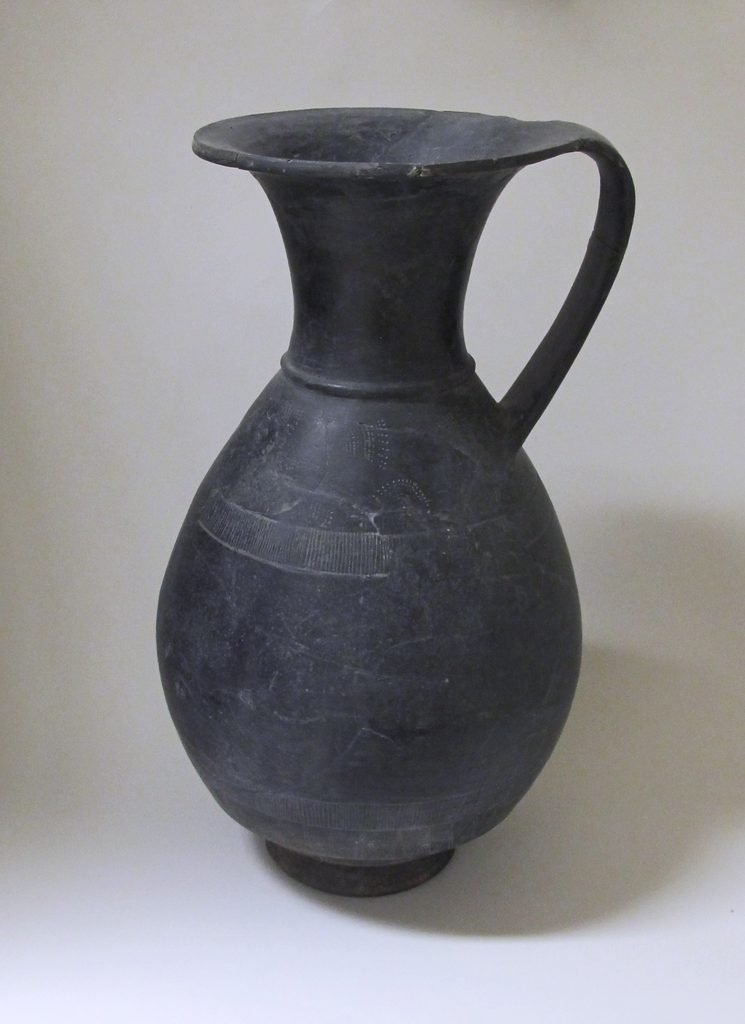
The mixture of imported and local pottery fits a wider Etruscan pattern. The Metropolitan Museum’s overview describes sustained contact with Greek communities and a strong appetite for Greek painted vessels. Etruscan craftspeople also developed their own forms. Bucchero, recognisable by its dark surface, often drew on the shapes of metal vessels. [5]
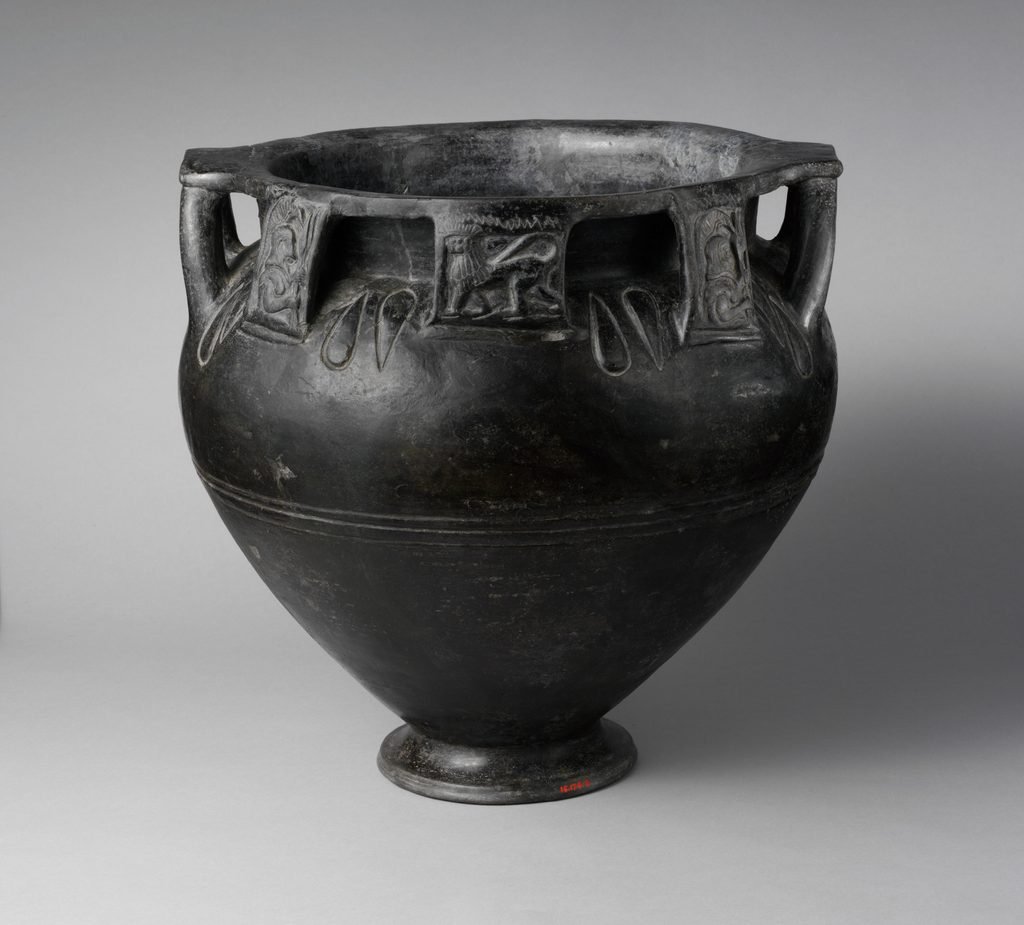
A later bucchero column-krater at the Met makes that process tangible. Dated to about 560–500 BC, it belongs to a type produced around Vulci. Its form drew on Corinthian models, but its unusually elaborate handles show local adaptation. It is a comparison for the craft tradition, not one of the newly excavated vessels. [7]
One proposed connection in the new tomb remains tentative: the excavators suggest that the alabaster lamp probably came from Naukratis or Rhodes. That is a reported attribution, not a securely established itinerary. Even if its production centre is confirmed, an imported object alone would not identify the birthplace of the person buried with it or every stop along its journey. [1]
What the tomb can tell us—and what remains unknown
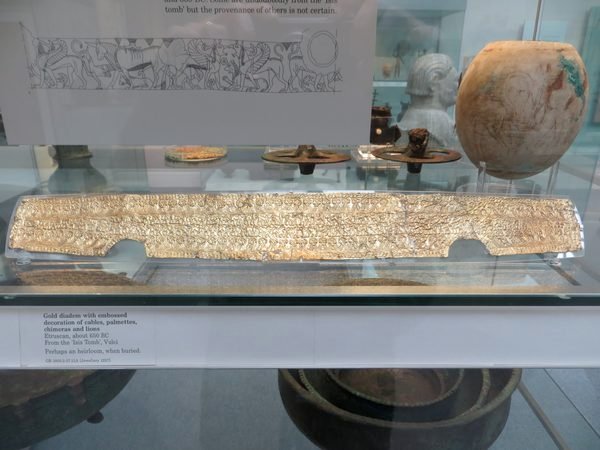
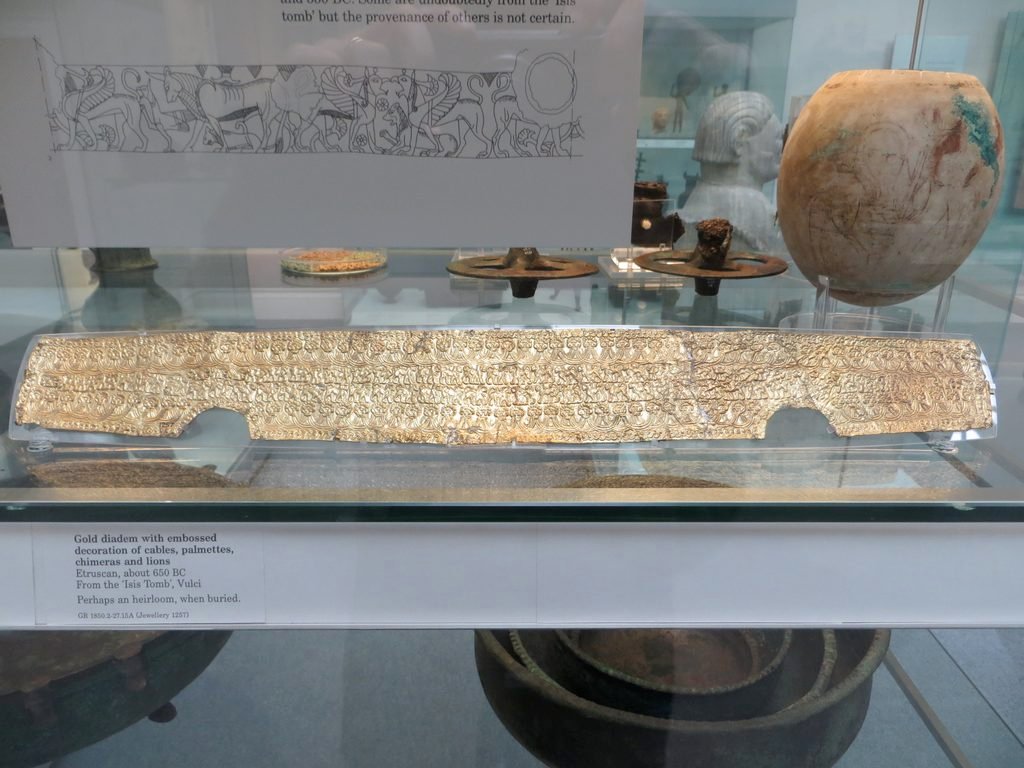
The archaeological authority places the discovery alongside the nearby Isis Tomb, whose rich assemblage was recovered in the nineteenth century. The comparison concerns Vulci’s elite funerary culture; the two tombs are separate discoveries. The archival museum photograph accompanying this article shows a diadem from the Isis Tomb, not treasure recovered in 2026. [1] [2]
The announcement presents the new burial as important evidence for Vulci’s aristocracy. It does not identify a named ruler or establish the personal histories of its occupants. A rich assemblage supports an interpretation of high status, but neither precious materials nor an imposing chamber can supply a name, a political title or a family relationship on their own. [1]
The next level of understanding depends on detailed study: which objects belong together, how the deposits were arranged, and how disturbance altered what survived. The project’s earlier research explains the broader problem at Vulci, where old excavations and looting have dispersed both objects and records. Reuniting that evidence is part of the work, alongside excavation itself. [2]
What happens next at Vulci?
The monument has already been reburied for protection, according to the official announcement. Further fieldwork is planned for 2027. The September report therefore should not be read as an announcement that visitors can enter the newly excavated chambers. [1]
For now, the discovery offers an unusually valuable opportunity to study surviving burial arrangements in a damaged monument. The important story is how much can still be learned from objects whose relationships remain recoverable. See the official excavation announcement for photographs of the actual 2026 work, and return to Ancient Knowledge for evidence-based reporting as further results become available. [1]
Sources and further reading
- Soprintendenza Archeologia Belle Arti e Paesaggio per la provincia di Viterbo e per l’Etruria Meridionale, Italian Ministry of Culture. Vulci – Una nuova scoperta nella necropoli della Polledrara: la Tomba della Camera di pietra. 22 September 2026. Primary announcement of the excavation results; includes photographs of the 2026 work. Read source
- Alessandro Conti, Christian Mazet and Laura Maria Michetti. “Ritorno a Vulci”. New tools for the study of the south-eastern necropolises. 2024. Archeologia e Calcolatori 35.1, pp. 67–80. DOI: 10.19282/ac.35.1.2024.06. Background and research methods, published before the 2026 excavation. Read source
- ARPAMED. Retour à Vulci : exploration du Tumulus Gsell. Undated; consulted 29 September 2026. Project-support account describing 2025 work and plans for 2026, not a final excavation report. Read source
- École française de Rome. Les chantiers de fouilles de l’EFR et du CJB en 2026. 28 May 2026. Published fieldwork schedule. Read source
- Colette Hemingway and Seán Hemingway, The Metropolitan Museum of Art. Etruscan Art. 1 October 2004. Read source
- The Metropolitan Museum of Art. Bronze funnel-strainer. Etruscan, about 550–500 BC. Accession 34.11.8. Comparative evidence for wine-serving equipment. Read source
- The Metropolitan Museum of Art. Terracotta column-krater (bowl for mixing wine and water). Etruscan, about 560–500 BC. Accession 16.174.8. Comparative object, not a 2026 find. Read source
- The Metropolitan Museum of Art. Terracotta oinochoe (jug). Etruscan, about 650–600 BC. Accession 96.18.115. Comparative object, not a 2026 find. Read source