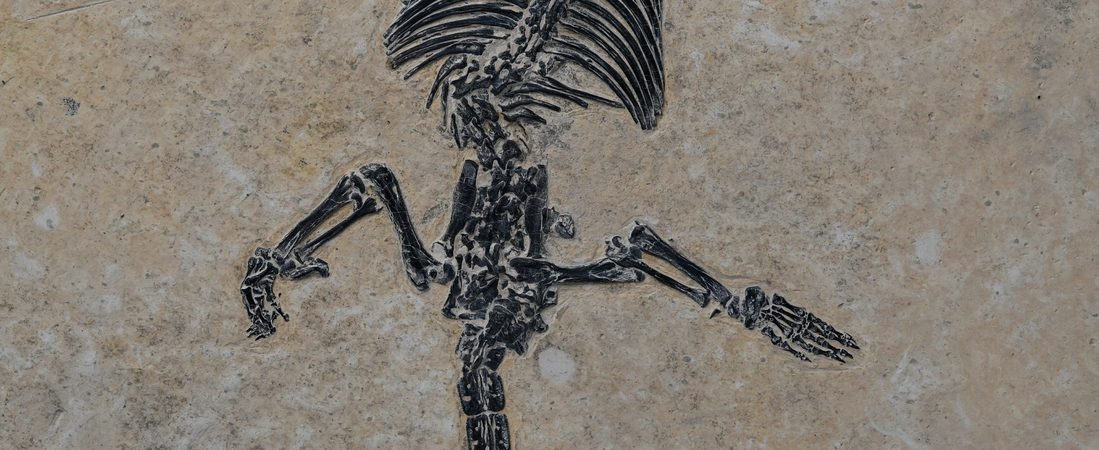
Most living mammals follow a familiar dental pattern: teeth are replaced only once at most positions. A newly described fossil from northeastern China complicates that rule.
The animal, named Dongoconodon platycauda, lived during the Early Cretaceous about 120 million years ago. Its nearly complete skeleton preserves an unusual combination of features. Some tooth positions appear to have produced a third generation of teeth, while the limbs and tail show adaptations consistent with a semiaquatic lifestyle.
Published in Nature Communications on September 28, 2026, the fossil does not overturn everything scientists know about mammal evolution. Instead, it reveals something more interesting: important mammalian traits did not necessarily evolve together in a simple, one-way sequence.
A Nearly Complete Mammal From the Age of Dinosaurs
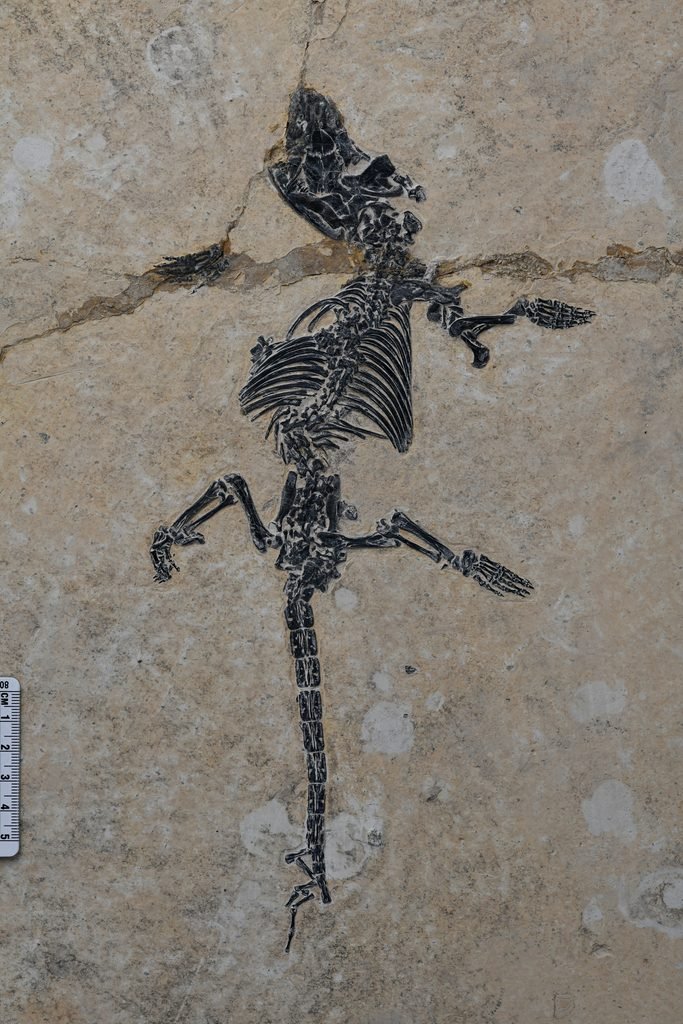
Dongoconodon is known from a single specimen, catalogued as IMMNH-PV01700 and housed at the Inner Mongolia Museum of Natural History in China.
The fossil was collected in 2016 from the Changzigou locality of the Jiufotang Formation near Lingyuan in Liaoning Province. The scientific paper dates the deposits to approximately 120 million years ago. The skeleton is remarkably complete and articulated, preserving the skull, jaws, vertebral column and most of the limbs. Only the right humerus, ulna and radius are missing.
Researchers estimate that the animal weighed between 115 and 190 grams, roughly within the range of a small water vole. It belonged to Eutriconodonta, an extinct group of Mesozoic mammals that included both tiny species and much larger predators such as Repenomamus.
Its name also carries a scientific history. “Dong” honors Chinese vertebrate paleontologist Junshe Dong, while “conodon” refers to cone-shaped teeth. The species name platycauda combines roots meaning “flat” and “tail,” reflecting one of the animal’s most distinctive anatomical features.
But the most surprising evidence was not in the tail. It was inside the jaws.
The Tooth Pattern Hidden Inside the Fossil
Modern mammals are usually described as diphyodont: they develop no more than two generations of teeth at a given position. Humans provide a familiar example, with deciduous teeth followed by permanent teeth.
Dongoconodon appears to have followed a different pattern at several positions.
Its upper jaw contains 11 tooth positions and the lower jaw ten. The fossil preserves teeth at different stages of eruption and development, allowing researchers to reconstruct the replacement sequence. In the canine and in some incisor and premolar-like positions, the anatomy indicates a third generation of teeth.
The lower first molariform is especially striking. The original tooth had already been shed, a replacement was developing within the jaw, and beneath that replacement researchers identified a small enamel cap that appears to represent another generation.
That does not mean Dongoconodon continuously replaced every tooth throughout its life like a crocodile or shark. The evidence concerns particular tooth positions, and the number and timing of replacements across the animal’s whole lifetime remain unknown.
The authors use the term “molariform” rather than simply “molar” for an important reason. In living mammals, true molars are normally defined in part by the fact that they are not replaced. Fossils preserving unusual replacement patterns make that terminology less straightforward.
Among mammals, a comparable case is known in Gobiconodon borissiaki, a related Mesozoic form interpreted from several specimens as having three generations of some molariform teeth. Dongoconodon expands that picture by preserving evidence of repeated replacement across more than one tooth type.
Why a Third Tooth Generation Matters
The usual two-generation mammalian tooth pattern is not an isolated feature. It has long been discussed alongside other major changes in mammalian biology, including precise tooth-to-tooth occlusion and more determinate patterns of body growth.
That can encourage a tidy evolutionary story: once mammals acquired a restricted replacement system, the rest of the modern package followed.
Dongoconodon makes that story less linear.
The researchers argue that eutriconodontans preserved a mosaic of traits. Some features looked strongly mammalian and specialized, while others followed patterns that are rare or absent among living mammals. In this lineage, repeated tooth replacement may have reappeared after a more restricted replacement system had already evolved earlier in mammalian history.
The authors suggest that this dental flexibility could have been connected with ecological specialization. Dongoconodon had a robust jaw and anterior teeth consistent with carnivory, and related gobiconodontids were also predators. Replacing heavily used teeth more than once could have been advantageous.
But that remains an evolutionary interpretation, not a directly observed behavior. The fossil does not preserve a lifetime feeding record, and one specimen cannot establish exactly why the replacement pattern evolved.
A Small Mammal Built for the Water
Dongoconodon was unusual for more than its teeth.
Its hands and feet are broad and elongated relative to the limbs. The arrangement of the metacarpals, metatarsals and digits would have allowed the fingers and toes to spread, increasing the surface area available to push against water.
Several finger bones also preserve flanges in positions comparable to attachment areas for interdigital webbing in the modern platypus. The comparison does not mean Dongoconodon was a platypus or a close relative. It means similar mechanical demands can produce similar anatomical solutions in unrelated lineages.
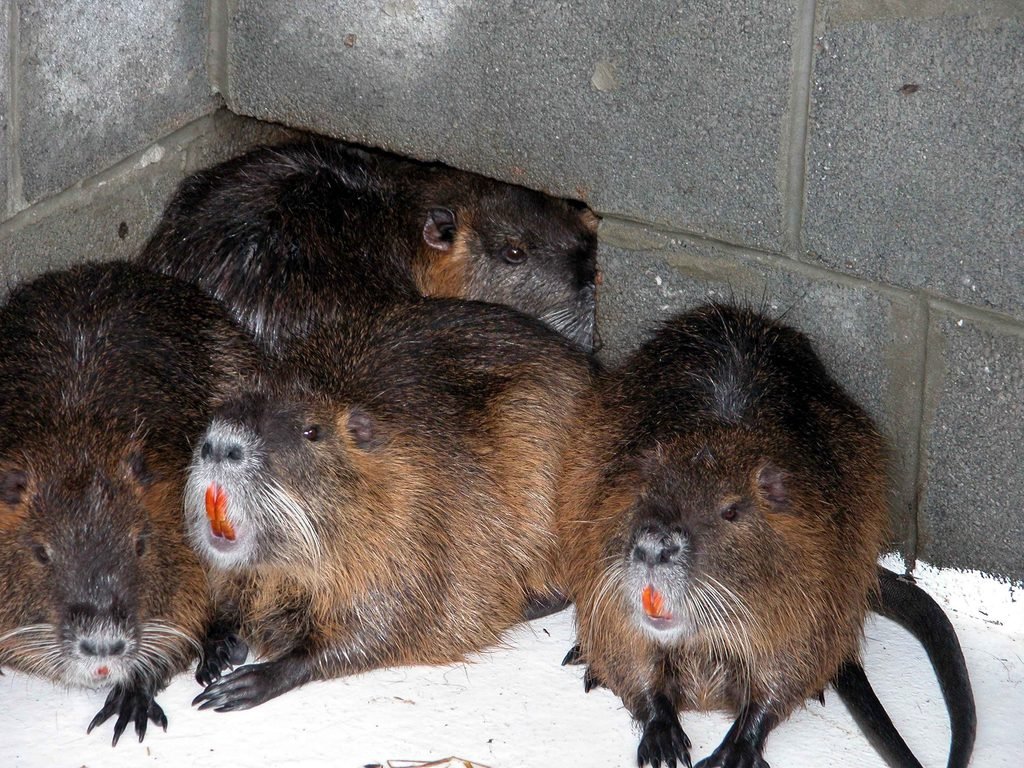
The tail tells a different part of the swimming story. Dongoconodon preserves at least 19 tail vertebrae. The proximal and transitional vertebrae are flattened in a way that differs from the broad paddle-like tail of a beaver or platypus. Instead, researchers compare the overall tail design with the tapered tail of the modern nutria, or coypu.
From this anatomy, the study proposes a swimming style in which the forelimbs provided much of the propulsion while the flattened tail helped with steering and stability.
The team also tested the interpretation statistically. They compared 13 functional skeletal indices with a dataset of 124 living mammal species representing several locomotor categories. Dongoconodon plotted within the semiaquatic morphospace, with the model assigning it a 100 percent posterior probability of semiaquatic locomotion.
That number should not be read as literal certainty about an extinct animal’s behavior. The same classification analysis had an overall accuracy of 61.3 percent across the modern comparison sample, while semiaquatic species were classified correctly 77.8 percent of the time.
The statistical result therefore supports the anatomical interpretation rather than replacing it.
It Was Not a Platypus Ancestor
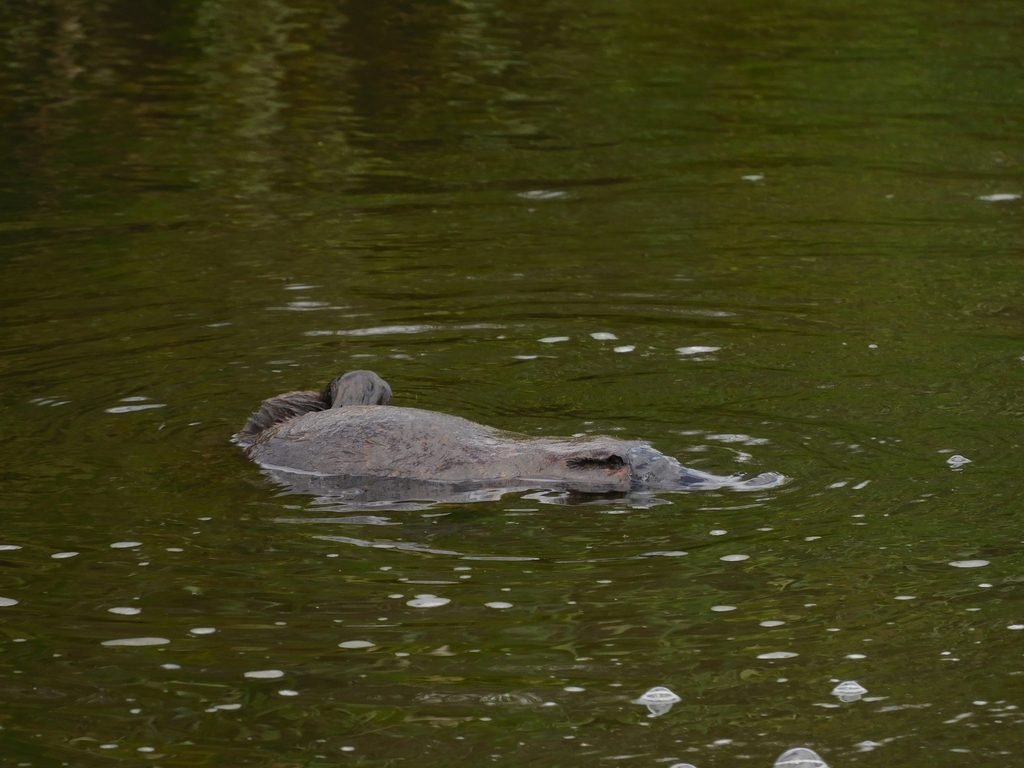
The platypus comparison is useful, but it can easily be misunderstood.
Dongoconodon belonged to an extinct eutriconodontan lineage. The living platypus is a monotreme, part of a different branch of mammalian evolution. Their similar limb features are best understood as convergence: separate lineages evolving comparable structures because they faced similar challenges in the water.
The same caution applies to its tail. A resemblance to the nutria does not imply close relationship. The comparison is functional and anatomical.
Semiaquatic life was also not unique to Dongoconodon among Mesozoic mammal relatives. Castorocauda, described from much older Jurassic rocks in China, had a broad, beaver-like tail and clear aquatic specializations. Other Early Cretaceous forms, including Liaoconodon and Yanoconodon, have also been interpreted as semiaquatic.
What makes Dongoconodon important is its particular combination: a different tail design, platypus-like limb proportions, unusual tooth replacement and informative middle-ear anatomy all preserved in one skeleton.
A Fossil Ear Records Another Evolutionary Transition
The fossil also preserves evidence from one of the defining transformations in mammalian evolution: the separation of the middle ear from the lower jaw.
In early mammalian relatives, structures that eventually became part of the hearing apparatus were still connected to the jaw. During mammalian evolution, those structures became increasingly specialized for hearing.
Dongoconodon preserves the malleus, incus, stapes and ectotympanic, together with an ossified Meckel’s cartilage. In this specimen, that cartilage has only a small area of contact with the lower jaw.
The authors interpret this anatomy as supporting a stepwise transition in which the connection to the jaw was reduced before the remaining relationship with the middle-ear bones disappeared. Research on mammalian development has also shown how breakdown of Meckel’s cartilage can separate the middle-ear structures from the jaw.
Again, the important message is not that Dongoconodon represents a direct stage on a straight line toward modern mammals. Different eutriconodontans preserve different combinations of jaw, ear and dental features.
Evolution was assembling and modifying these systems in a more mosaic pattern.
What the Fossil Does — and Does Not — Prove
Dongoconodon is known from one individual. That makes the specimen exceptionally informative, but it also sets clear limits.
Its skeleton strongly supports a semiaquatic interpretation, yet the exact swimming stroke, speed and amount of time spent in water cannot be observed directly. The bones indicate structures compatible with webbed feet, but the complete soft-tissue shape of those feet cannot be reconstructed with certainty.
The dental evidence supports a third generation at several tooth positions, but it does not show unlimited replacement throughout the entire mouth or throughout life.
The proposed connection between repeated replacement and carnivory is plausible, not demonstrated by direct feeding observations.
And a single skeleton cannot reveal the normal range of variation within the species.
What it can show is already remarkable.
By about 120 million years ago, at least one small mammal living alongside dinosaurs combined a specialized semiaquatic body with a dental replacement pattern that looks unexpectedly unlike the standard pattern of most living mammals.
That combination matters because it makes early mammal evolution harder to reduce to a ladder of progressively “modern” features.
Dongoconodon instead points to experimentation: teeth, hearing structures and locomotion could change along partly independent evolutionary paths.
And sometimes a tiny fossil preserves enough evidence to show that the history of mammals was more flexible than the living world alone would suggest.
Sources and further reading
The primary source should be Shundong Bi, Yukun Shi, Zhiyu Li et al., “A polyphyodont, semiaquatic eutriconodontan mammal from the Early Cretaceous of China,” Nature Communications 17, 10032, published September 28, 2026. Primary Nature Communications study
Nanjing University also published an institutional summary describing the semiaquatic adaptations and the unusual dental evidence. Nanjing University research summary
For broader context on aquatic Mesozoic mammal relatives, the 2006 Science study of Castorocauda remains important; the Carnegie Museum summary documents its Jurassic semiaquatic adaptations. ScienceDaily
For the jaw-to-middle-ear transition, the developmental evidence from Meckel’s cartilage is summarized in the 2017 study by Anthwal and colleagues. PubMed