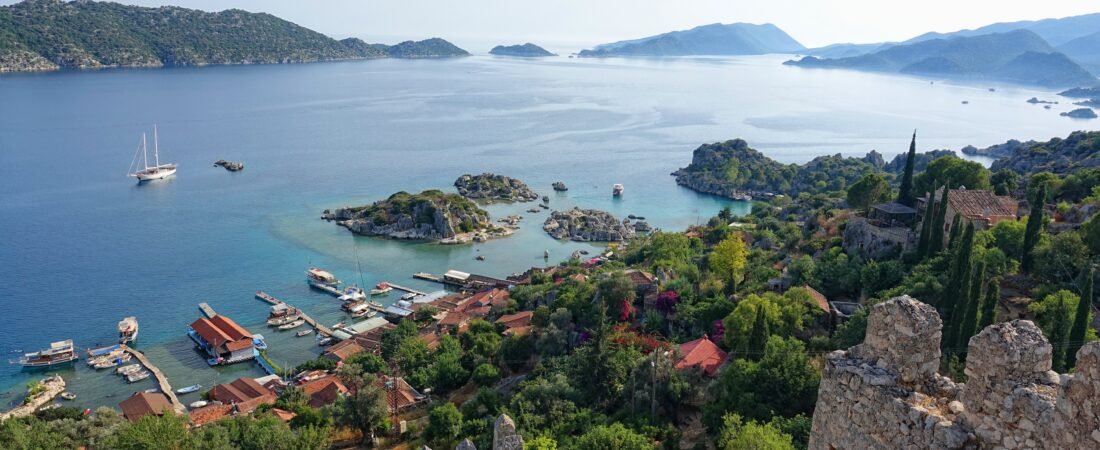
Nearly 5,000 years ago, a small vessel disappeared beneath the waters off what is now the Mediterranean coast of Türkiye.
Its wooden hull did not survive.
Its cargo did.
Scattered across the seabed near Kekova are ceramic storage vessels whose forms point to the Early Bronze Age, approximately 2600–2400 BC.
In October 2026, the wreck attracted international attention after Turkish officials described it as the world’s oldest known shipwreck.
If the current dating and interpretation hold, the site may predate the famous Dokos wreck in Greece by several centuries.
But the story is more complicated than a simple archaeological record.
The wreck was documented before the October announcement, no ship timbers survive for direct dating, and some interpretations of its cargo remain preliminary.
What archaeologists do have is a remarkable collection of pottery that may preserve evidence of maritime trade across the eastern Mediterranean more than four millennia ago.

A New Announcement From an Older Discovery
The October headlines made the Kekova wreck appear completely new.
The archaeological work has a longer history.
Akdeniz University documented the site during research in the Kekova region in 2024.
Researchers recorded the distribution of visible material on the seabed using detailed photographic documentation and orthophotography.
Two amphorae were recovered for closer examination—one in 2024 and another in 2025.
A preliminary scientific report on the wreck was published in 2026 before the major October announcement.
Full excavation work began in 2026 under the Antalya Museum Directorate, with Hakan Öniz of Akdeniz University serving as scientific director.
On October 14 and 15, new public statements brought the site into international news.
So the important distinction is simple:
the wreck was not physically discovered on October 14, 2026.
October marked a major public announcement of the ongoing investigation and its implications.
What Survived on the Seabed
The wooden ship itself has disappeared.
After thousands of years underwater, exposed timber can be consumed by biological activity and destroyed by physical processes.
What remains at Kekova is primarily the cargo and associated archaeological material.
Current reports describe more than 30 ceramic storage vessels scattered across the underwater site at roughly 30 metres depth.
Researchers have also documented stone anchors nearby.
The preliminary scientific report describes two three-holed anchors and one single-holed anchor.
However, the authors explicitly caution that it is not yet known which, if any, of those anchors belonged to the ship.
That uncertainty is important.
Objects lying close together underwater are not automatically part of the same wreck.
Archaeologists must establish association through context, dating and excavation.

How Do You Date a Shipwreck With No Ship?
Usually, surviving wood can offer powerful chronological evidence.
At Kekova, there is no preserved hull available for direct radiocarbon dating.
Instead, archaeologists have relied heavily on ceramic typology.
Pottery changes over time.
Vessel proportions, handles, bases, surface treatment and decoration can be compared with examples recovered from securely dated archaeological contexts elsewhere.
The Kekova vessels have features comparable to Early Bronze Age ceramic forms in the eastern Mediterranean and Levant.
Researchers therefore place the wreck broadly in the third millennium BC.
Current public reports give a range equivalent to approximately 4,400–4,700 years ago, while archaeological discussion places the material around 2600–2400 BC.
This type of dating can be strong.
But it is different from directly dating surviving ship timber.
That distinction is one reason the phrase “world’s oldest known shipwreck” should still be treated as a current archaeological interpretation rather than an eternal fact.
The Amphorae Point Toward the Eastern Mediterranean
The shape of the jars provides more than a date.
It may also reveal where the cargo originated.
The preliminary report describes the wreck’s amphorae as generally similar to Early Bronze Age Levantine types, with side handles and flat bases.
More recent public statements from Akdeniz University report that clay analysis points toward workshops in the Jordan Valley.
Comparable vessel traditions are known from archaeological contexts in Egypt, Troy and Crete.
That does not prove one exact voyage from one named port to one named destination.
It does place the ship within a much larger world of exchange.
Long before the famous Late Bronze Age trade networks documented by wrecks such as Uluburun, communities around the eastern Mediterranean were already moving goods across significant distances by sea.
What Was the Ship Carrying?
Large ceramic containers were the freight packaging of the ancient Mediterranean.
They could transport liquids and other commodities while being stacked or secured aboard vessels.
Researchers have suggested that some Kekova jars may have carried products such as wine or olive oil.
Residues preserved inside some of the vessels may eventually provide stronger evidence.
For now, the contents should not be treated as conclusively identified.
The preliminary scientific study describes one recovered amphora as resembling commercial containers used for agricultural products such as wine or olive oil.
That is an interpretation based on vessel form and parallels.
Chemical and residue studies may refine the answer.
The difference between “could have carried” and “did carry” matters.
A shipwreck preserves cargo, but archaeology still has to determine what that cargo actually was.
The Strange Vessel With Nine Marks and Two Holes
One vessel has attracted particular attention.
Akdeniz University reports that it carries nine distinct marks and two holes in its body.
Initial interpretation suggests that it may have functioned as a type of churn used in producing cheese or butter.
That possibility has led researchers to ask whether sailors could have produced dairy products during long voyages.
Some public discussion has gone even further, proposing that crews may have carried live goats, milked them at sea and processed the milk on board.
This is fascinating.
It is also preliminary.
The unusual vessel may offer evidence for food preparation at sea, but reconstructing an entire system of livestock transport from one container requires caution.
Further analysis of the vessel, residues and archaeological context will determine how far that interpretation can go.
Where Was the Vessel Going?
The origin and destination of the ship are not directly written anywhere on the wreck.
Researchers are reconstructing possible routes from the ceramics.
The eastern Mediterranean parallels and reported Jordan Valley clay signatures suggest connections with the Levant.
Akdeniz University says the team is considering the possibility that the vessel departed from a port on the Levantine coast and was traveling westward when it sank near Kekova.
Troy and Crete have been proposed as possible destinations because comparable pottery has been identified there.
These remain route hypotheses.
The ship may have stopped at multiple ports.
Its cargo may have been assembled from more than one source.
And without a surviving log, inscription or identifiable destination cargo, the wreck cannot tell us exactly where its captain intended to finish the voyage.
What it does show is that the sea was already connecting distant communities during the Early Bronze Age.
Is It Really the World’s Oldest Known Shipwreck?
This is the question behind the headlines.
Turkish officials have described the Kekova site as the world’s oldest shipwreck.
Its estimated date would place it several centuries earlier than the well-known Early Bronze Age wreck at Dokos in Greece.
That makes the claim archaeologically important.
But “oldest known” is always conditional.
New discoveries can change the record.
Dating can be refined.
And archaeologists still have to distinguish a coherent wreck assemblage from cargo and anchors deposited through different events.
At Kekova, the absence of surviving hull timbers means the vessel itself cannot currently be dated directly by its wood.
The age rests largely on the pottery and archaeological context.
The safest formulation is therefore that Kekova is a strong candidate for the oldest known shipwreck yet identified.
That wording preserves the importance of the evidence without presenting an active research question as permanently settled.
The Famous Sunken Ruins of Kekova Are Something Else
Kekova is already internationally known for underwater ruins visible along its coast.
Those remains belong to much later historical periods.
They are not the Early Bronze Age shipwreck.
This distinction is especially important when selecting photographs for the article.
A beautiful image of submerged walls around Kekova can illustrate the region’s underwater archaeological landscape, but it should never be captioned as the 4,700-year-old wreck.
The Bronze Age wreck belongs to an entirely different chapter of the area’s history.
The same coastline has preserved evidence from many periods.
That is part of what makes underwater archaeology there so valuable.
Why the Wreck Matters More Than the Record
Whether Kekova keeps the title of “oldest” for five years, fifty years or only until the next excavation is not the most important part of the discovery.
The real value is what the cargo can reveal.
The ceramics may document trade between the Levant, Anatolia, the Aegean and Egypt at an unexpectedly early stage.
Clay analysis can identify production regions.
Residue analysis may reveal commodities.
Pottery distribution can help reconstruct routes.
Unusual vessels may preserve evidence of daily life aboard ships.
And the wreck itself shows that moving significant cargo by sea was already part of the eastern Mediterranean economy during the Early Bronze Age.
A record attracts attention.
Context creates history.
What Comes Next
The Kekova investigation is still active.
Excavation and conservation can reveal more about how the cargo was arranged, whether additional objects lie beneath sediment and whether the nearby anchors truly belong to the vessel.
Residue analysis may clarify what the containers held.
Further ceramic and clay study may strengthen or revise proposed origins.
Researchers may also refine the chronology.
That makes the wreck particularly valuable to follow over the coming years.
The most extraordinary thing about Kekova is not simply that a ship may have sunk there around 4,500 years ago.
Ships must have been crossing these waters long before written shipping records survive.
What is extraordinary is that enough of one lost voyage remained on the seabed for archaeologists to begin reconstructing it.
The ship vanished. Its cargo became its history.
Sources and Further Reading
- Öniz, Hakan and Ceyda Öztosun. “Preliminary Report on the Early Bronze Age Shipwreck in the Kekova Region of Antalya.” Journal of Maritime Archaeology 21(3), 2026. DOI: 10.1007/s11457-026-09532-3. Preliminary scientific report — Journal of Maritime Archaeology
- Akdeniz University. “A Discovery From Akdeniz University That Will Enter the History of World Archaeology.” October 15, 2026. Akdeniz University — official 15 October report
- Anadolu Agency. “4,700-Year-Old Amphorae Discovered Near Türkiye’s Kekova Island.” October 14, 2026. Akdeniz University — official 15 October report
Anadolu Agency — 14 October announcement - Smithsonian Magazine. “A New Contender for the World’s Oldest Shipwreck Has Been Discovered Off the Coast of Turkey.” October 14, 2026. Smithsonian — independent coverage