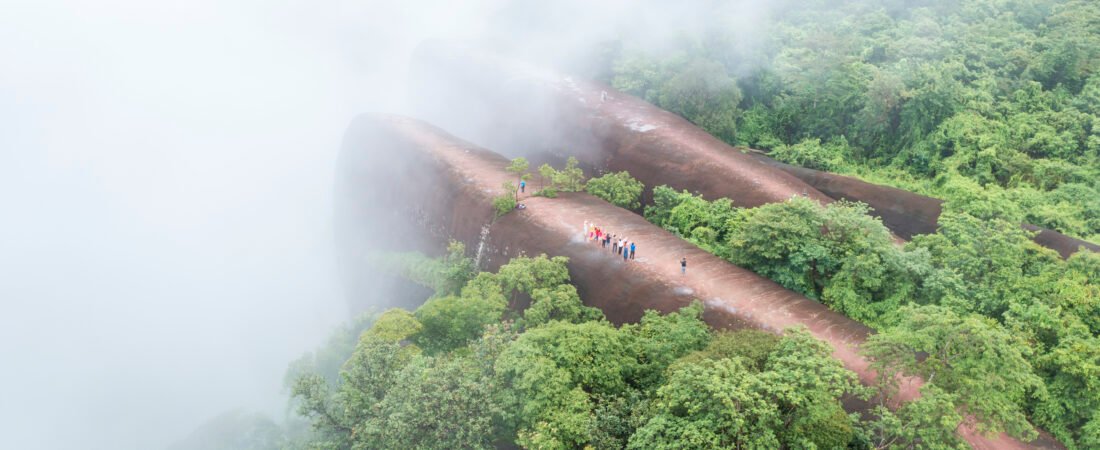
From above, they seem almost alive. Three enormous dark forms emerge from the forest of northeastern Thailand, their long rounded backs resembling whales swimming through an ocean of green. They are known as Hin Sam Wan—“Three Whale Rock”—one of the most distinctive geological landmarks in Bueng Kan Province. The resemblance is striking enough that the three formations are commonly imagined as a family: a father, a mother and a calf. But no sculptor created them. They are natural sandstone outcrops, part of the rugged landscape of Phu Sing. Thailand’s official geological and tourism sources describe the rocks as approximately 75 million years old. That age belongs to the sandstone itself. The whale-like shapes seen today developed much later, gradually emerging as natural weathering and erosion transformed the surrounding rock over immense spans of time.
THREE WHALES ABOVE THE FOREST
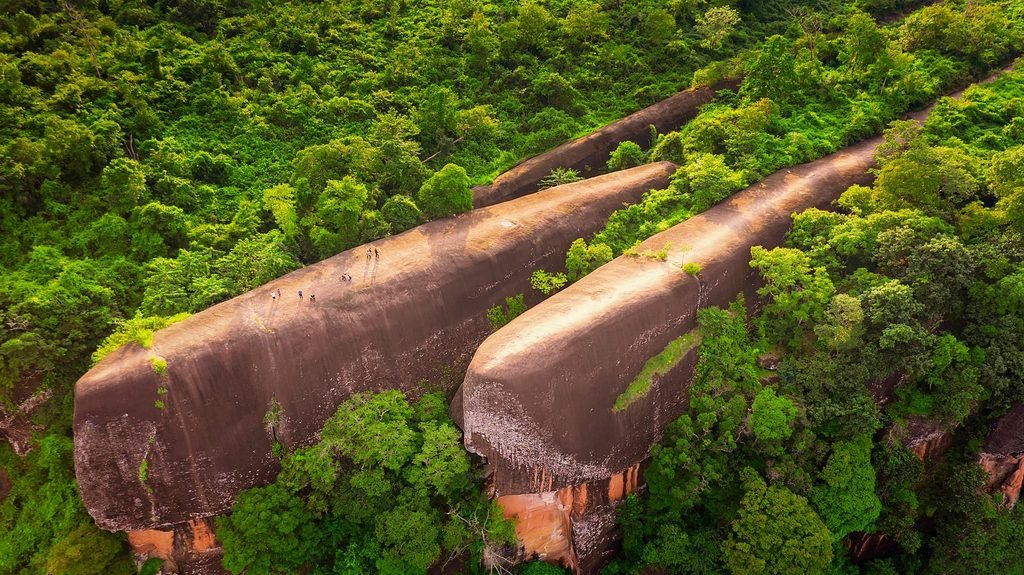
Hin Sam Wan lies within the Phu Sing landscape of Bueng Kan Province in northeastern Thailand. The wider area covers roughly 12,000 rai and forms part of protected national-reserved forest land associated with the Kala tropical forest, Phu Sing Forest and Dong Si Chomphu Forest. Phu Sing is dominated by sandstone terrain. Across the landscape, visitors encounter cliffs, caves, broad rock terraces and isolated formations shaped into unusual forms by geological processes. Among them, none has become more recognizable than Hin Sam Wan. Three enormous sandstone bodies extend toward the edge of the high ground, lying almost parallel to one another. Viewed from above or from certain positions nearby, their broad curved surfaces create an extraordinary optical resemblance to whales moving together through the forest canopy. The largest is traditionally called the father whale. The second is the mother. The smallest is imagined as their calf. The names are human. The rocks are entirely natural.
WHAT DOES “75 MILLION YEARS OLD” ACTUALLY MEAN?
The phrase “75-million-year-old whales” makes an effective headline, but it needs an important geological distinction. The rocks were not necessarily shaped like whales 75 million years ago. The approximate age refers to the ancient sandstone from which the formations are made. Thailand’s Department of Mineral Resources identifies Hin Sam Wan as a geomorphological sandstone feature about 75 million years old. That places the rock in the Late Cretaceous, during a period when dinosaurs still inhabited the planet. But landscapes are not frozen at the moment their rock forms. After sediment becomes sandstone, the landscape can be uplifted, fractured, exposed and gradually altered. Water enters cracks. Temperature changes weaken surfaces. Plants grow in crevices. Rain removes loosened grains. Over very long periods, erosion strips away weaker material while more resistant masses remain. The modern whale-like appearance is therefore the product of a long geological history rather than a single ancient event.
NATURE DID NOT CARVE THREE WHALE STATUES
Photographs can make Hin Sam Wan look almost too perfect. That has encouraged descriptions that sometimes make the rocks sound as though they were deliberately shaped. They were not. There is no evidence that ancient people carved the formations into whales. Nor are they giant sculptures hidden in the forest. Their resemblance to animals is an example of how human perception recognizes familiar shapes in natural forms. Geology created three elongated masses of sandstone. Human imagination supplied the family story. The same Phu Sing landscape contains other formations whose shapes have also inspired names based on animals and familiar objects. This does not make the formations less remarkable. If anything, knowing that the forms emerged naturally over geological time makes the landscape more extraordinary.
WHY THREE SEPARATE ROCK MASSES REMAIN
Sandstone commonly develops fractures and joints. Once exposed at the surface, those weaknesses provide pathways for water and weathering. Over time, erosion can widen the divisions between blocks and remove material from around them. At Hin Sam Wan, three major sandstone outcrops remain separated enough to appear as distinct bodies. Their long, relatively smooth upper surfaces give them the characteristic whale-back appearance. The surrounding forest greatly strengthens the illusion. From the air, the dark sandstone contrasts with dense green vegetation on every side. Instead of seeing isolated rocks on a mountain, the eye sees three dark creatures apparently moving through a green sea. The famous image is therefore the result of two different natural systems working together: ancient geology below and living forest around it.
PHU SING IS MORE THAN THREE WHALE ROCK
Hin Sam Wan is the most internationally recognizable part of Phu Sing, but the surrounding landscape contains many other geological features. Official tourism material describes sandstone cliffs, caves, rock terraces and clusters of unusually shaped formations spread across the area. Among the named attractions are viewpoints and formations resembling an elephant, a train and other familiar objects. This concentration of sandstone landforms makes Phu Sing valuable not simply as a scenic destination but as a place where visitors can observe the effects of weathering and erosion across an entire landscape. The rocks preserve geological history. The shapes visible today record what happened after that rock was exposed to the surface environment. Some formations remain broad and massive. Others have fractured. Some form cliffs. Others survive as isolated blocks. Hin Sam Wan is simply the most visually dramatic expression of that much larger geological story.
A VIEW TOWARD THE MEKONG AND LAOS
The position of the formations near the edge of the high ground makes Hin Sam Wan an exceptional viewpoint. Tourism sources describe views across the forests of Bueng Kan toward the Mekong region and the mountains of Laos. On clear mornings, the landscape can stretch far beyond the sandstone itself. This is one reason sunrise has become closely associated with the site. Light moves across the forest below while the rock surfaces catch the first sun from the horizon. Visitors can access the larger formations, though the exposed cliff environment requires care. The smaller “baby whale” is generally not used as a walking surface. The dramatic viewpoint is part of the appeal—but it also reminds visitors that these are natural cliffside formations, not constructed observation platforms.
THE WHALE FAMILY EXISTS ONLY FROM THE RIGHT PERSPECTIVE
One of the most interesting things about Hin Sam Wan is how dependent the illusion is on viewpoint. From above, the relationship between the three forms becomes immediately obvious. Their spacing, alignment and curved backs resemble three whales traveling together. From ground level, however, the experience changes. The formations become enormous walls and platforms of sandstone. The animal-like outline is less obvious because the viewer is too close to see the complete arrangement. This is a reminder that many famous natural shapes depend on perspective. The geology exists regardless of where we stand. The whale appears only when the human eye assembles the shapes into something familiar.
A CRETACEOUS ROCK IN A MODERN FOREST
The approximate 75-million-year age gives Hin Sam Wan another layer of significance. When the sandstone was forming during the Late Cretaceous, the world was profoundly different. Continents occupied different positions. Global climates were unlike those of today. Dinosaurs still dominated terrestrial ecosystems. The forest now surrounding the rocks is not a surviving Cretaceous forest. The modern trees are part of a much younger ecosystem. This distinction matters. The rock is ancient. The current vegetation is not. What visitors see today is therefore a landscape assembled from elements of very different ages: Cretaceous sandstone and a living modern forest. That contrast is part of what makes aerial photographs so compelling.
WHY NATURAL LANDMARKS CAN LOOK DESIGNED
The position of the formations near the edge of the high ground makes Hin Sam Wan an exceptional viewpoint. Tourism sources describe views across the forests of Bueng Kan toward the Mekong region and the mountains of Laos. On clear mornings, the landscape can stretch far beyond the sandstone itself. This is one reason sunrise has become closely associated with the site. Light moves across the forest below while the rock surfaces catch the first sun from the horizon. Visitors can access the larger formations, though the exposed cliff environment requires care. The smaller “baby whale” is generally not used as a walking surface. The dramatic viewpoint is part of the appeal—but it also reminds visitors that these are natural cliffside formations, not constructed observation platforms.
PROTECTED LANDSCAPE, NOT A MAN-MADE MONUMENT
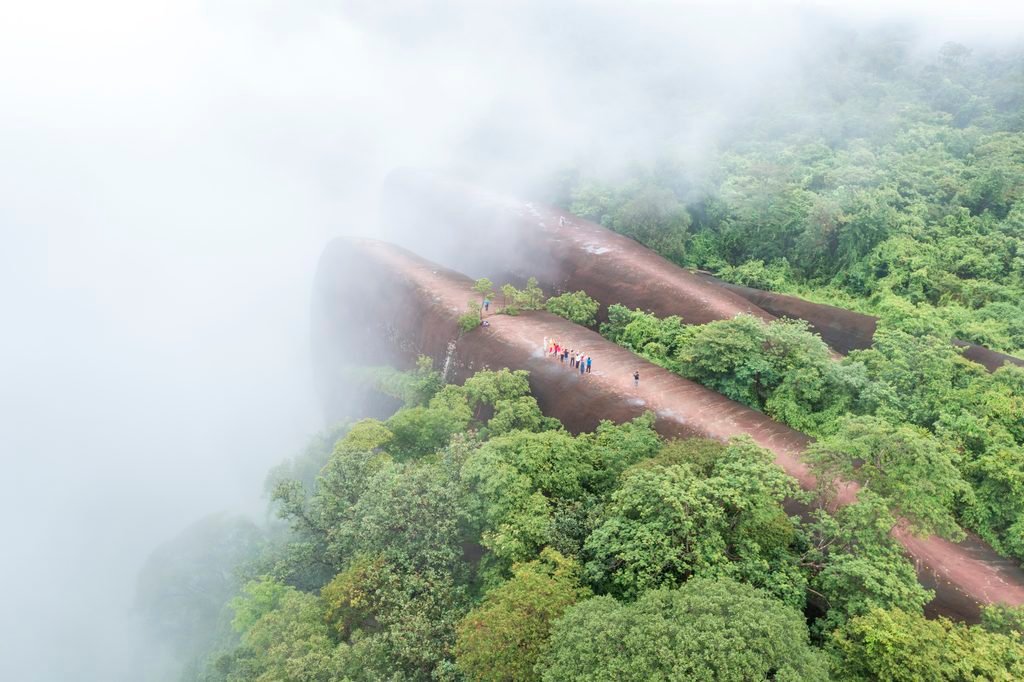
Another important distinction is that Hin Sam Wan should not be described as a monument in the archaeological sense. It is not an ancient construction. It contains no evidence in its whale-like form of deliberate human engineering. Its significance comes from natural geology, landscape and modern cultural interpretation. Today, the rocks are part of a protected forest environment and a major natural attraction of Bueng Kan. Tourism has given the formations an international audience. Drone photography has given them their most famous perspective. But neither created the feature itself. The sandstone existed long before anyone called the rocks whales.
THE WHALES THAT NEVER SWAM
The name Hin Sam Wan transforms three masses of stone into a story. A father. A mother. A calf. Swimming together through an endless green forest. Geology tells a different story, but one that is no less extraordinary. Sediment became sandstone. The landscape changed. Rock fractured. Weather and water removed material. Resistant masses remained. Then, millions of years later, people looked down from above and recognized something familiar. The rocks never swam. They were never whales. Yet from the right perspective, three pieces of ancient sandstone can make a forest appear to become an ocean. Nature shaped the stone. Human imagination gave it life.
Hin Sam Wan belongs to a long tradition of natural landmarks named after animals, people or objects. Humans are extremely good at finding recognizable patterns. A curve becomes a face. A cliff becomes an animal. Three sandstone masses become a family of whales. This phenomenon does not require the shapes to be perfect. Our brains fill in the missing details. From the correct angle, Hin Sam Wan supplies just enough information: elongated bodies, rounded backs and three different sizes. The forest does the rest by visually surrounding the rocks like water. The resulting image feels almost intentional. Geologically, however, there was no plan.
1. Thailand Department of Mineral Resources — official geological material identifying Hin Sam Wan in Bueng Kan as a geomorphological site consisting of three large sandstone masses and giving an approximate age of 75 million years. กรมทรัพยากรธรณี
Thailand Department of Mineral Resources — geological publication
2. Tourism Authority of Thailand — Hin Sam Wan, Giant Whale-Shaped Rocks @ Bueng Kan. Official description of the site, 75-million-year age, three formations and protected forest setting. Tourism Authority of Thailand
Tourism Authority of Thailand — Hin Sam Wan
3. Tourism Authority of Thailand — 10 Things to Do in Bueng Kan. Provides broader information on Phu Sing, its approximately 12,000-rai protected landscape, sandstone terrain, caves, cliffs, rock terraces and named formations. Tourism Authority of Thailand
Tourism Authority of Thailand — Phu Sing and Bueng Kan
4. National Geographic / Tourism Authority of Thailand — describes Hin Sam Wan as a 75-million-year-old formation and documents views toward the Mekong and mountains in Laos from the rock area. National Geographic
National Geographic — Three Whale Rock