Most dinosaur fossils preserve only part of a skeleton.
Borealopelta markmitchelli is something very different.
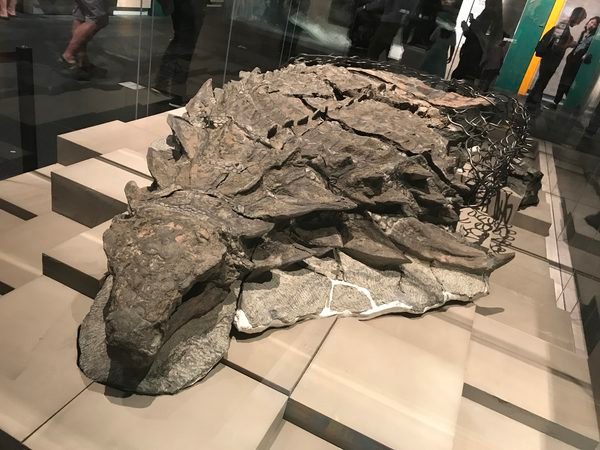
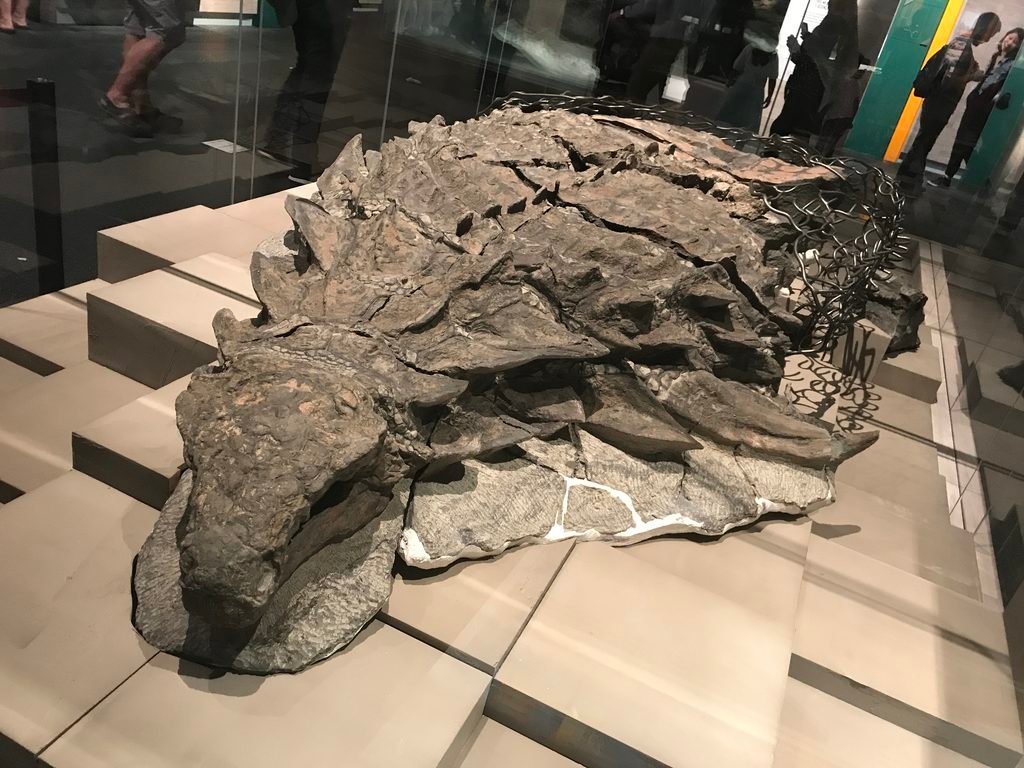
This Early Cretaceous armored dinosaur preserves much of the front half of its body in three dimensions, with fossilized skin, armor plates still arranged across the body, remnants of the keratinous coverings that once capped them, evidence linked to pigmentation, and even genuine stomach contents.
The Royal Tyrrell Museum describes the specimen as the best-preserved armoured dinosaur in the world. It dates to approximately 112–110 million years ago, making it one of Alberta’s most extraordinary windows into dinosaur biology.
Rather than showing scientists only the bones of an extinct animal, Borealopelta preserves part of what the dinosaur looked like on the outside—and what it had been eating shortly before it died.
An Accidental Discovery in an Alberta Oil-Sands Mine
The fossil’s modern story began on March 21, 2011, at Suncor’s Millennium Mine north of Fort McMurray, Alberta.
Heavy-equipment operator Shawn Funk noticed unusual material while working through the mine. Royal Tyrrell Museum scientists were contacted, and what initially emerged from the surrounding rock proved to be an armored dinosaur of exceptional preservation.
The animal came from the Wabiskaw Member of the Clearwater Formation, deposits laid down in a marine environment during the Early Cretaceous.
That location is remarkable in itself. Borealopelta was a terrestrial herbivore, yet its body ended up in sediments deposited offshore.
Researchers have therefore interpreted the carcass as having been transported into the sea before sinking and becoming buried. The unusual burial conditions helped protect the body from the normal destruction caused by scavengers, decay and physical disturbance.
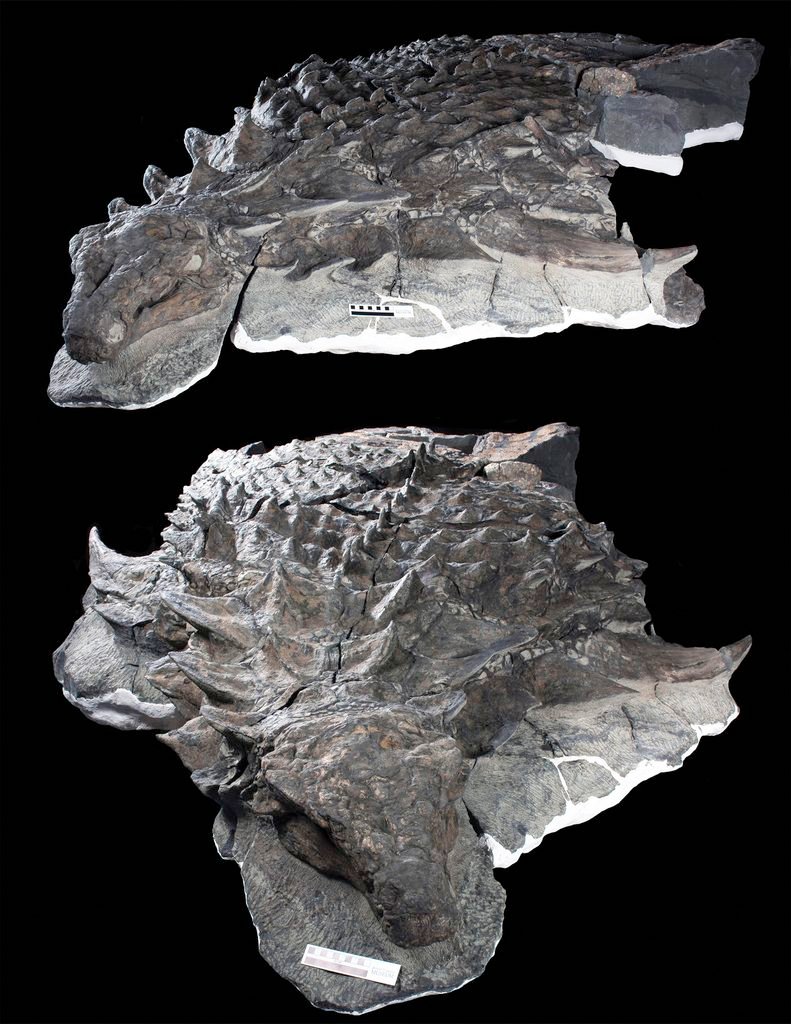
What survived was not a complete dinosaur from nose to tail. The holotype, catalogued as TMP 2011.033.0001, preserves the head, neck, much of the trunk and sacral region, forelimb material and other parts of the body.
But what makes it extraordinary is not simply how much is present.
It is how those parts were preserved.
Armor Still Sitting Where It Was in Life
Most armored-dinosaur fossils consist of bones and isolated osteoderms—the bony plates embedded in the skin.
In Borealopelta, the armor remains largely in its anatomical position.
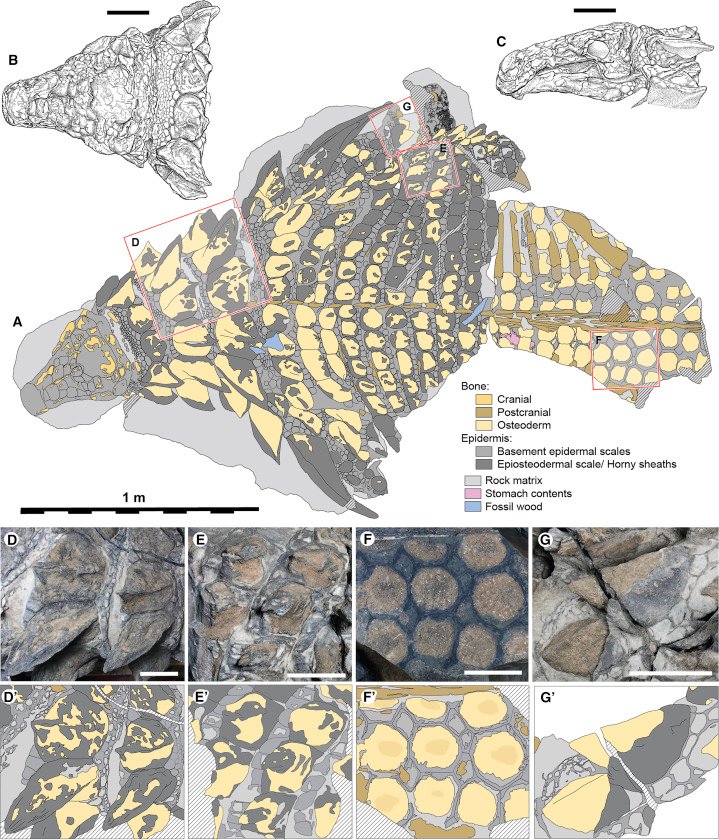
The specimen preserves broad fields of fossilized scales, osteoderms and the remains of the keratinous sheaths that covered many of those bony structures. The original scientific description emphasized that these tissues were preserved across large areas of the body in three dimensions.
The preservation is so extensive that, in places, the skeleton underneath is actually obscured by the fossilized skin and armor.
Royal Tyrrell Museum material describes the specimen as preserved from the snout toward the hips, encased in body armor and soft-tissue remains.
Researchers estimated that the living animal was around 5.5 metres long and weighed more than 1,300 kilograms.
It belonged to Nodosauridae, a group of ankylosaurs that relied on heavy body armor rather than the large tail clubs associated with some other armored dinosaurs.
Yet its armor is only one reason the fossil became scientifically important.
Did Borealopelta Preserve Its Original Color?
In 2017, researchers analyzed organic residues preserved in the fossil’s skin and horn-like coverings.
The team reported chemical evidence associated with melanin and interpreted the distribution of pigmentation as consistent with countershading—a darker upper body grading toward a lighter underside.
They also reported evidence consistent with a reddish-brown coloration.
Countershading is common in living animals because it can reduce the visual effect of shadows and make the body’s three-dimensional form harder to detect.
For Borealopelta, this interpretation was particularly interesting.
An animal weighing well over a tonne and covered with heavy armor might seem to have had little need for camouflage. Yet researchers argued that countershading could indicate significant predation pressure even on a heavily protected herbivore.
There is an important limit, however.
The fossil does not preserve a perfect color photograph from the Cretaceous.
Reddish-brown coloration and countershading are scientific reconstructions based on chemical and anatomical evidence. They are evidence-based interpretations, but they should not be presented as a perfectly known record of the dinosaur’s exact appearance in life.
The Fossil Also Preserved Its Last Meal
Years after the dinosaur was formally described, researchers examined another remarkable feature preserved inside its abdominal region.
A distinct mass of material was interpreted as genuine stomach contents, known scientifically as a cololite.
The 2020 study used several independent lines of evidence—including its location inside the body, its composition and associated gastroliths—to support the conclusion that the material represented food the animal had actually consumed.
This is unusually valuable.
Paleontologists can often estimate dinosaur diets from teeth, jaw mechanics and plant fossils found in the same environments.
But preserved stomach contents provide something much more direct: evidence of what one individual had recently eaten.
And in Borealopelta, the meal was preserved in extraordinary detail.
Ferns Dominated the Menu
Microscopic analysis revealed that approximately 88 percent of the identifiable plant material consisted of leaves.
Within the leaf material, about 85 percent consisted of leptosporangiate ferns.
Cycad or cycad-like foliage occurred in much smaller quantities, while conifer material appeared only in traces.
Researchers therefore concluded that this particular Borealopelta had been feeding heavily—and possibly selectively—on ferns.
The stomach contents also contained stems, wood and other plant fragments.
But one component was especially intriguing:
charcoal.
About 6 percent of the analyzed plant material consisted of burnt fragments.
Researchers suggested that the dinosaur may have been feeding in vegetation recovering after a wildfire, where young ferns were growing through a recently disturbed landscape.
The study could not determine whether Borealopelta intentionally consumed charcoal or swallowed it accidentally together with its food.
Either way, those tiny burnt fragments preserve evidence not only of the dinosaur’s diet, but potentially of the landscape through which it had been moving.
A Brief Moment From One Dinosaur’s Life
The stomach contents should not be treated as a complete menu for the entire species.
Researchers cautioned that the fossil represents one animal and one brief feeding event, probably covering only a relatively short period before death.
What this individual ate shortly before it died may not represent what every Borealopelta ate throughout the year.
Seasonal evidence provides another clue.
A preserved woody fragment showed an incomplete growth ring, while mature spores were present in fern and clubmoss material.
Together, these observations were considered consistent with feeding during the growing season, probably from late spring to mid-summer.
For a fossil more than 110 million years old, that is an extraordinary level of biological detail.
Scientists are not merely identifying the animal.
They can begin reconstructing a brief episode from its life: the vegetation it selected, a landscape affected by fire and even approximately when during the growing season it had been feeding.
More Than 7,000 Hours of Preparation
None of this information was immediately visible when the fossil arrived at the Royal Tyrrell Museum.
Museum technician Mark Mitchell spent more than 7,000 hours removing the surrounding rock and preparing the specimen for scientific study and display.
When the dinosaur was formally named in 2017, the species name markmitchelli was chosen in his honor.
The preparation revealed a fossil whose scientific value extended far beyond a conventional skeleton.
Its armor helped researchers investigate how osteoderms and their keratinous coverings were arranged.
Its soft tissues offered evidence about external appearance.
Its chemical residues provided clues to pigmentation.
And its stomach preserved direct evidence of feeding ecology.
Few individual dinosaur specimens bring so many different areas of paleontology together.
Why Borealopelta Matters
Exceptional fossils can sometimes answer questions that ordinary skeletons cannot.
A bone can reveal anatomy.
A tooth can suggest diet.
A footprint can record movement.
But Borealopelta preserves several biological systems together.
Its armor remains connected to the body.
Its skin preserves the external surface.
Its organic residues provide evidence relevant to coloration.
Its stomach contents show what one animal actually ate.
Even charcoal inside that final meal may preserve information about the environment through which it moved.
That combination is why the Royal Tyrrell Museum describes Borealopelta as the best-preserved armored dinosaur in the world.
Today, the specimen remains on display at the Royal Tyrrell Museum in Drumheller, Alberta.
More than 110 million years after the animal died, Borealopelta markmitchelli offers something unusually close to a biological portrait.
Not simply a collection of fossil bones—but armor, skin, traces of color and the remains of a meal eaten only a short time before death.
Sources and further reading
1. Brown, C. M., Henderson, D. M., Vinther, J. et al. (2017).
An Exceptionally Preserved Three-Dimensional Armored Dinosaur Reveals Insights into Coloration and Cretaceous Predator-Prey Dynamics. Current Biology 27. This is the primary description of Borealopelta markmitchelli and the principal source for the skin, armor, pigmentation and countershading interpretation. ScienceDirect
Primary 2017 Current Biology study
2. Brown, C. M. et al. (2020).
Dietary palaeoecology of an Early Cretaceous armoured dinosaur based on floral analysis of stomach contents. Royal Society Open Science 7:200305. This is the primary source for the fern-dominated meal, charcoal and seasonal evidence. The paper is CC BY 4.0. PubMed Central (PMC)
Open-access stomach-content study
3. Brown, C. M. (2017).
An exceptionally preserved armored dinosaur reveals the morphology and allometry of osteoderms and their horny epidermal coverings. PeerJ. Useful for the armor and keratinous coverings. PubMed Central (PMC)
4. Royal Tyrrell Museum.
Museum material confirms the age range, extraordinary preservation, more than 7,000 hours of preparation and current status of Borealopelta as the museum’s best-preserved armored dinosaur.