The chemical signature locked into a tooth can preserve a trace of childhood long after a person’s name has disappeared. In a study published on September 23, 2026, researchers compared strontium isotope data from 199 people buried at six archaeological sites in central and southern Greece. Seventeen had signatures outside the local ranges established for the communities where they were buried. [1] [2]
The pattern was more selective than a story of mass relocation. The researchers identified non-local men and women, found no clear overall gender bias, and reported the highest proportion of non-locals among young adults aged 18 to 30. Their results suggest that individual movement—often involving young people—was more characteristic than the resettlement of entire families. The evidence does not reveal why any particular person moved or identify an exact birthplace. [1]
What the new study examined
The peer-reviewed PLOS ONE study brought together material from Apollo Maleatas, Ayios Vasileios, Kirrha, Keros, Kalyvia and Voudeni. The sites cover different parts of central and southern Greece and span periods from the Final Neolithic and Early Bronze Age into the Middle and Late Bronze Age. Most of the analysis focused on communities living during the transition toward and through the Mycenaean period. [1] [2]
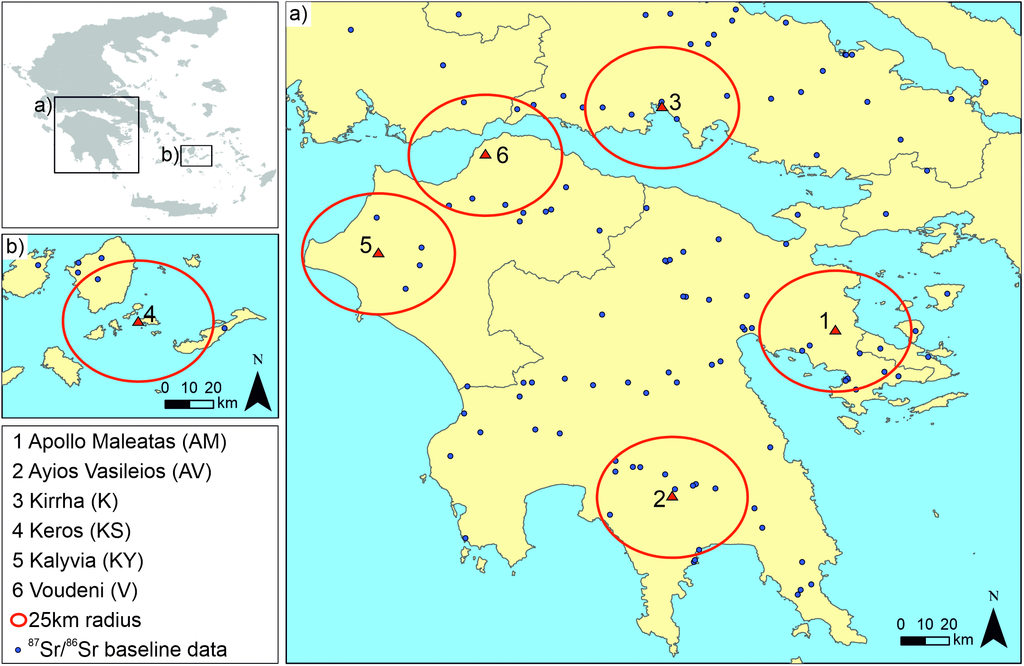
Researchers sampled tooth enamel from 107 individuals and dense petrous bone from 92. Tooth enamel is especially useful because it forms during childhood and does not remodel later in life. Its strontium isotope ratio can therefore be compared with the bioavailable strontium of the landscape around a burial site. A mismatch may indicate that the person spent part of childhood elsewhere. [1] [5] [6]
How strontium can trace childhood landscapes
Strontium enters food and water from local geology, passes through plants and animals, and becomes incorporated into human tissues. Different rock formations can produce different ratios of the isotopes strontium-87 and strontium-86. Archaeologists use samples from the environment and local burials to build a baseline, then compare human enamel or bone against that range. [5] [6]
The method does not work like a postal address. Two distant regions can share similar isotope values, while diet, sea spray and imperfect environmental sampling can complicate a local baseline. In Greece, overlapping geological signatures are a particular limitation. A result inside the local range cannot prove that someone never moved, and a result outside it usually narrows the possibilities rather than identifying one village of origin. [1] [5] [6]
Seventeen people were classified as non-local
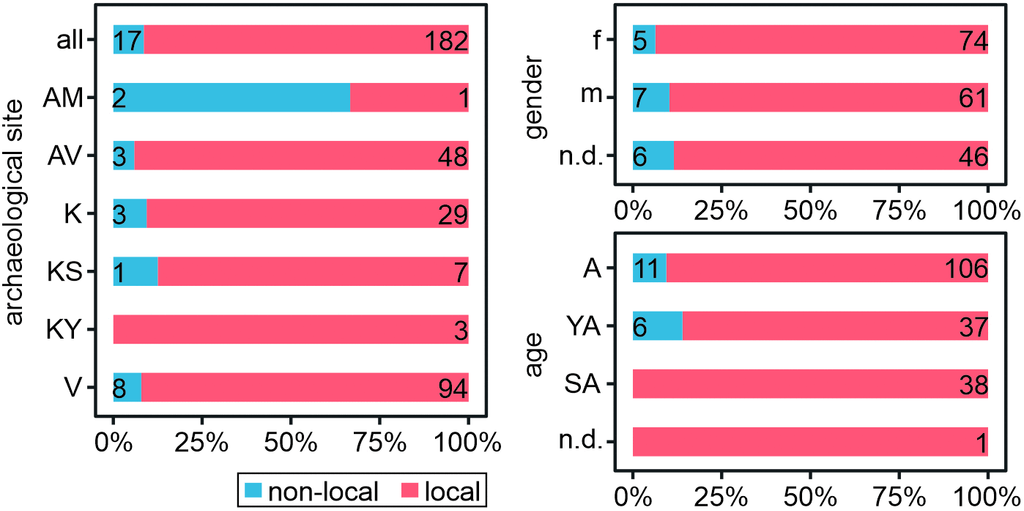
Of the 199 individuals, 17 had strontium signatures outside one or both baselines calculated for their burial community. That is about 8.5 percent of the full sample. Across different phases of the Bronze Age, the study generally identified no more than roughly 5 to 10 percent as non-local. The authors treat these figures as minimum estimates because movement between isotopically similar areas may remain invisible. [1] [4]
The site-level percentages varied, but small samples can make those differences look more dramatic than they are. Apollo Maleatas, for example, had only three individuals in the dataset, while Voudeni contributed more than one hundred. The study therefore gives greater weight to patterns across the combined material than to headline comparisons between every cemetery. [1]
Young adults were the most mobile age group
Age produced the clearest pattern. Fourteen percent of the young adults in the study were classified as non-local, compared with 9.4 percent of adults over 30. None of the sampled sub-adults under 18 fell outside the local ranges. This supports the interpretation that movement often involved individuals at the beginning of adult life rather than parents relocating with children. [1] [2]
Even that conclusion requires care. Researchers analyzed only one skeletal sample from each person, so they could not reconstruct a personal timeline of movement. A young adult who was non-local at death might have moved as an infant, a teenager or shortly before burial. The age at death is not automatically the age at migration. The paper explicitly calls for future studies that sample several teeth formed at different stages of childhood. [1]
The results do not support a simple gender rule
Earlier models have often emphasized women moving between patrilineal communities through marriage. This study found non-local signatures among both men and women. Of the individuals assigned a biological sex, 6.3 percent of females and 10.3 percent of males were non-local, but sex could not be determined for 58 people, including six non-locals. The authors therefore concluded that no strong overall gender bias could be established. [1] [2]
That does not rule out marriage, warfare, craft training, trade, labor, ritual travel or political ties as reasons for movement. It means the current evidence does not reduce mobility to one practice. Grave wealth also failed to produce a simple division: non-local individuals appeared in both modest and richly furnished burials. Isotope chemistry can identify a geographical mismatch, but social motives must be tested with burial context, kinship evidence, ancient DNA and other archaeological data. [1] [2]
Non-local does not necessarily mean foreign to Greece
The isotope signatures identified movement toward the burial communities from more than one geological zone. At Ayios Vasileios and Voudeni, some non-local values fell above the local baseline and others below it, suggesting multidirectional movement. Yet every non-local signature was also compatible with environmental values documented somewhere in modern Greece. The study therefore cannot establish international migration from the isotope evidence alone. [1] [5]
Some people may have moved only a short distance. Several signatures remained close to the environmental range calculated within roughly 25 kilometres of the burial site. Others could match multiple regions around the Mediterranean. The most defensible conclusion is that these people grew up outside the baseline defined for the community where they were buried—not that researchers have mapped a specific route across the Aegean. [1]
Voudeni offers a view of one studied community
Voudeni, near modern Patras, contains a large Mycenaean cemetery with chamber tombs used for repeated burials. Greece’s Ministry of Culture describes the cemetery as part of a significant settlement connected with routes toward the sea. In the 2026 study, Voudeni provided the largest group of individuals and showed non-local signatures pointing in more than one isotopic direction. [1] [7]
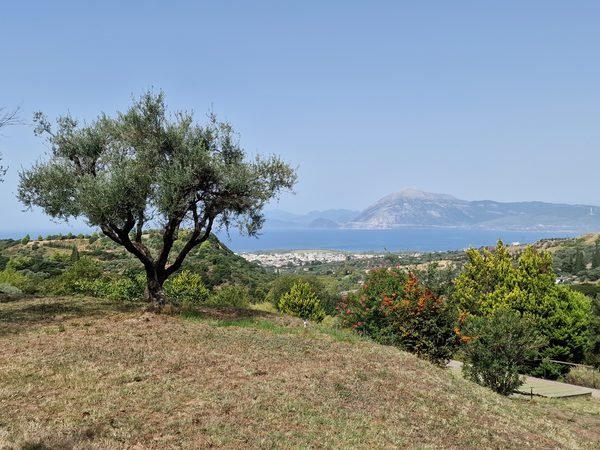
The featured photograph shows part of the Voudeni cemetery as it appeared in 2023. It documents one of the archaeological places included in the research, not the sampling process and not the grave of a particular person discussed in the paper. The study does not connect the photographed tombs with any named individual in the dataset. [8]
![[8]](https://commons.wikimedia.org/wiki/File:Voudeni_20230922_121339.jpg)
Why the finding matters
Bronze Age Greece was connected by the movement of goods, technologies and ideas, but objects alone cannot show whether the people who carried them settled in a new community. A foreign vessel might have arrived through exchange without its maker or owner ever relocating. Human isotope data adds another line of evidence by identifying individuals whose childhood environment differed from the place where they were buried. [1]
The emerging picture is neither a completely sedentary society nor a landscape of constant mass migration. Most sampled individuals appear compatible with local baselines, while a smaller group moved through multidirectional networks. Young adulthood may have been a particularly important stage for entering new communities. That interpretation is stronger than a single dramatic migration story because it rests on repeated evidence across six sites—and it remains open to revision as baselines and sample sizes improve. [1] [2] [3]
The study’s most useful lesson is methodological as well as historical. Chemical traces can reveal movement that grave objects cannot, but they do not recover a person’s name, journey or motive. For those questions, archaeology still needs several kinds of evidence working together. Explore the open-access study and its figures below, and return to Ancient Knowledge for more evidence-based reporting on the ancient world. [1]
Sources and further reading
- Anja B. Frank and colleagues, PLOS ONE. Exploring mobility in Bronze Age Greece: A Sr isotope perspective. September 23, 2026. Peer-reviewed open-access study of 199 individuals from six sites; methods, results and limitations. Read source
- University of Gothenburg. New study reveals Bronze Age mobility across ancient Greece. September 23, 2026. Institutional research announcement and author comments. Read source
- Archaeological Institute of America, ARCHAEOLOGY Magazine. Young People Were on the Move in Bronze Age Greece. September 28, 2026. Independent news coverage of the study’s principal result. Read source
- U.S. National Library of Medicine, PubMed. Exploring mobility in Bronze Age Greece: A Sr isotope perspective. 2026. Bibliographic record and study abstract. Read source
- Anja B. Frank and colleagues, Science of the Total Environment. The geographic distribution of bioavailable strontium isotopes in Greece – A base for provenance studies in archaeology. 2021. Environmental baseline research used for archaeological provenance studies in Greece. Read source
- R. Alexander Bentley, Journal of Archaeological Method and Theory. Strontium Isotopes from the Earth to the Archaeological Skeleton: A Review. 2006. Methodological review of strontium isotope analysis and its interpretive limits. Read source
- Hellenic Ministry of Culture and Sports. Mycenaean cemetery of Voundeni. Official archaeological-site overview and context. Read source
- Rigorius, Wikimedia Commons. Voudeni 20230922 121339.jpg. September 22, 2023. Photograph and CC BY-SA 4.0 license record for the Mycenaean cemetery at Voudeni. Read source